


Page 221 - The Complete Cat Breed Book (DK)
P. 221
SOCIALIZING Y OUR C A T          219

         scratching to get what they want. If that is the case, simply   Introducing children
         stop playing with him, say “no” in a firm voice, and give him   If you have small children, your cat may feel threatened and
         a toy instead. If your cat learns that biting or scratching   frightened by their exuberant, noisy behavior and sudden
         achieves the outcome he wants, it will be difficult to get him   movements—especially if they chase him. His preferred
         to break the habit. Give plenty of praise when your cat is   defense will be to run away, but when cornered he may
         playing nicely with you, but also praise him when he takes   respond by hissing, scratching, or biting, all of which may
         his aggression out on a toy. That way, he will learn that he   scare or hurt a small child. It pays to prepare your children
         can play hard with toys but not with you.        for the cat’s arrival by reading through a book about cat care
           New people need to be introduced with care. Never force   with them. First meetings should be supervised, especially if
         your cat to meet strangers. Instead, let him approach the   toddlers are involved. Let your cat or kitten take the initiative
         person when he is ready; once he realizes that nothing bad   and approach the child. If he decides to flee, let him go. Play
         is going to happen, he will be more confident and trusting.   sessions should involve the child sitting still on the floor with
         You can speed up the process by laying a trail of treats up to   a lure toy or ribbon that encourages the cat to come closer.
         the stranger. This works best when your cat is hungry. (You   To make your children feel involved, give each responsibility
         can also restrict treats to occasions when there is a visitor in   for some aspect of the cat’s care, such as filling the water bowl,
         the house.) When your cat is comfortable with the person, a   shaking out the bedding, putting his food away, or collecting
         friendly stroke or two on the head or back can be attempted.   his toys. To avoid overfeeding, make sure only one child has
         If you have to leave your cat to be looked after by friends or   the job of feeding your cat. Never let a young child clean out
         neighbors, get him used to the new people in advance. Ask   your cat’s litter box. Cat feces can carry intestinal parasites,
         them to come to your home frequently to feed him treats and   such as worms, and an infection called toxoplasmosis that can
         pet or play with him. He will soon look forward to their visits.  be harmful to a young child (p.211).

                                                          A new baby
                                                          If your cat has always been the center of attention, he may
                                                          become jealous of the competition for affection when
                                                          a new baby arrives. Some careful preparation can help
                                                          prevent this. Before the birth, allow your cat to examine
                                                          the baby’s room and gear, but make it clear that he is not
                                                          allowed in on his own and that the crib, bassinet, and
                                                          stroller are distinctly off limits. If you have friends or
                                                          family with a baby, ask them to visit so that your cat
                                                          becomes familiar with the sounds and smells. To
                                                          accommodate the new domestic situation, you may need
                                                          to change your cat’s routine or how much time you will be
                                                          spending with him. Introduce such changes gradually in
                                                          the months leading up to the birth. Likewise, if your cat
                                                          has any behavioral problems that you need to put right,
                                                          now is the time
                                                          to do it, since
                                                          they may get
                                                          worse when the
                                                          baby arrives.


                                                          A NEW COMPANION
                                                          The arrival of a new
                                                          baby need cause no
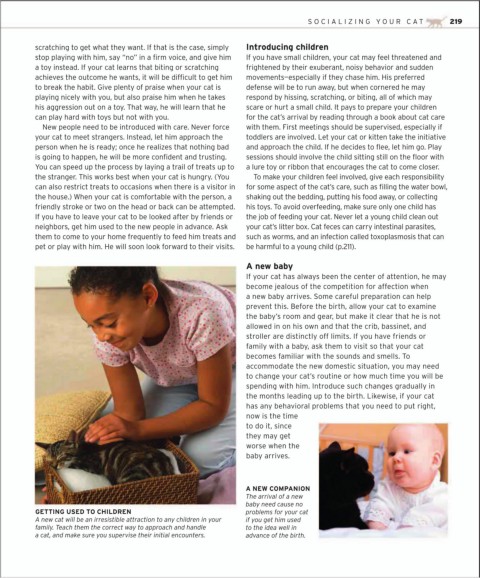
         GETTING USED TO CHILDREN                         problems for your cat
         A new cat will be an irresistible attraction to any children in your   if you get him used
         family. Teach them the correct way to approach and handle    to the idea well in
         a cat, and make sure you supervise their initial encounters.  advance of the birth.

