


Page 226 - The Complete Cat Breed Book (DK)
P. 226
224       C ARE AND BEHA VIOR


        CAT COMMUNICATION


        You can always tell when a dog is happy or sad—its emotions are
        written all over its face. You will find your cat more inscrutable when
        it comes to facial expressions, so it may be difficult to know what your
        cat is trying to tell you. Cats do, however, have a whole range of other
        behaviors and signals that you can learn to interpret, which will make
                                                                                      Learn to understand
        for much easier interaction between you and your cat.                              your cat


        How to speak cat                                 cats produce long wails known as caterwauls. Purring is
        Wild cats are solitary, predatory animals that patrol a territory   usually a sound of contentment, but cats also purr as a way
        they regard as exclusively theirs. Consequently, most cat   of comforting themselves when they are in pain or anxious.
        communications are designed to ward off intruders. Learning
        what your cat’s body language, and the noises he makes,   Body language
        mean will help you understand what he is trying to tell you.   Your cat will give you signals using his ears, tail, whiskers, and
          Chief among cat noises are hissing, growling, meowing,   eyes. Ears and whiskers usually work together. Normally the
        and purring. Hisses and growls—sometimes accompanied by   ears are erect and facing forward and the whiskers are to the
        a flash of teeth or show of claws—are warnings to strangers   front or sides, showing that your cat is alert and interested.
        trespassing on the cat’s territory or to humans who get too   When his ears are rotated back and flat and his whiskers are
        close. Meows—rarely used between adult cats—are mainly a   forward, he is feeling aggressive. Ears out to the sides and
        way for kittens to signal to their mother. Domestically, your   whiskers flat against the cheeks mean that your cat is scared.
        cat will use meowing to announce his presence. Short and   Cats don’t like eye contact, which is why your cat will often
        high-pitched chirps and squeaks usually signal excitement or   approach anyone in the room who ignores him: to him, this is
        a plea for something, but drawn-out and low-pitched sounds   friendly behavior. Once your cat is used to those around him,
        express displeasure or a demand. Rapid, intense, and loud,   he will find eye contact less threatening. Dilated pupils can
        repeated sounds often signify anxiety. Long, drawn-out cries   mean he is interested and excited or fearful and aggressive,
        and shrieks indicate that the cat is in pain or fighting. Mating   so always try to read the other signals he is giving out too.

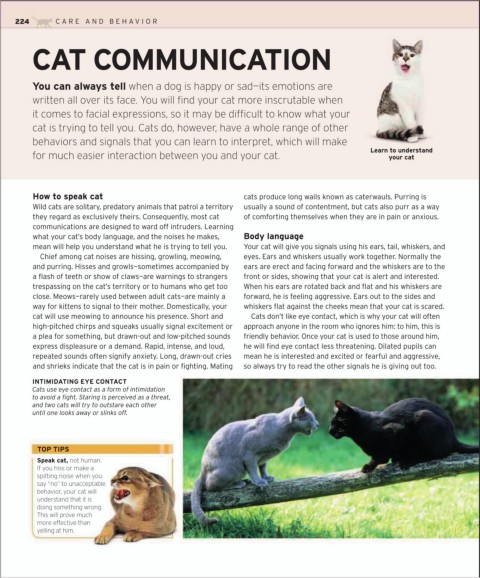
        INTIMIDATING EYE CONTACT
        Cats use eye contact as a form of intimidation
        to avoid a fight. Staring is perceived as a threat,
        and two cats will try to outstare each other
        until one looks away or slinks off.


          TOP TIPS
         Speak cat, not human.
         If you hiss or make a
         spitting noise when you
         say “no” to unacceptable
         behavior, your cat will
         understand that it is
         doing something wrong.
         This will prove much
         more effective than
         yelling at him.

