


Page 229 - The Complete Cat Breed Book (DK)
P. 229
THE IMPOR T ANCE OF PLA Y           227


           TOP TIPS
          ■     Supervise your cat’s use of   Furry           Fabric
          anything that could be chewed or   mouse            mouse
          shredded and swallowed. Bits of                    with bell
          string and fabric can cause
          intestinal blockages, while objects
          with sharp edges could damage
          your cat’s mouth.                                                                 Play balls
          ■     Make sure that curtain and
          window-blind cords are not
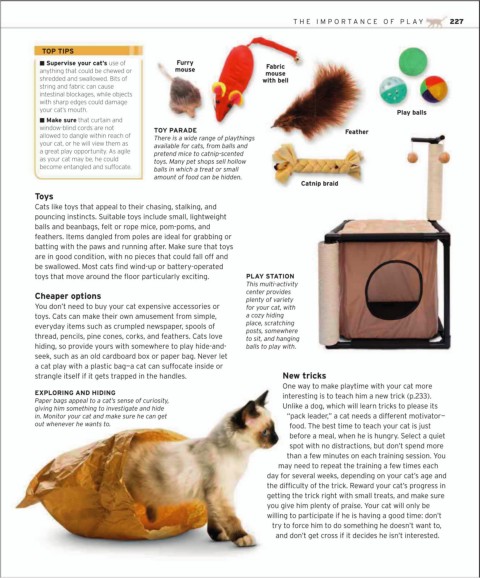
                                    TOY PARADE                                   Feather
          allowed to dangle within reach of
                                    There is a wide range of playthings
          your cat, or he will view them as
                                    available for cats, from balls and
          a great play opportunity. As agile
                                    pretend mice to catnip-scented
          as your cat may be, he could
                                    toys. Many pet shops sell hollow
          become entangled and suffocate.
                                    balls in which a treat or small
                                    amount of food can be hidden.
                                                                      Catnip braid
         Toys
         Cats like toys that appeal to their chasing, stalking, and
         pouncing instincts. Suitable toys include small, lightweight
         balls and beanbags, felt or rope mice, pom-poms, and
         feathers. Items dangled from poles are ideal for grabbing or
         batting with the paws and running after. Make sure that toys
         are in good condition, with no pieces that could fall off and
         be swallowed. Most cats find wind-up or battery-operated
         toys that move around the floor particularly exciting.  PLAY STATION
                                                          This multi-activity
                                                          center provides
         Cheaper options
                                                          plenty of variety
         You don’t need to buy your cat expensive accessories or   for your cat, with
         toys. Cats can make their own amusement from simple,   a cozy hiding
                                                          place, scratching
         everyday items such as crumpled newspaper, spools of
                                                          posts, somewhere
         thread, pencils, pine cones, corks, and feathers. Cats love   to sit, and hanging
         hiding, so provide yours with somewhere to play hide-and-  balls to play with.
         seek, such as an old cardboard box or paper bag. Never let
         a cat play with a plastic bag—a cat can suffocate inside or
         strangle itself if it gets trapped in the handles.       New tricks
                                                                  One way to make playtime with your cat more
         EXPLORING AND HIDING                                     interesting is to teach him a new trick (p.233).
         Paper bags appeal to a cat’s sense of curiosity,
         giving him something to investigate and hide             Unlike a dog, which will learn tricks to please its
         in. Monitor your cat and make sure he can get             “pack leader,” a cat needs a different motivator—
         out whenever he wants to.                                  food. The best time to teach your cat is just
                                                                    before a meal, when he is hungry. Select a quiet
                                                                    spot with no distractions, but don’t spend more
                                                                   than a few minutes on each training session. You
                                                                 may need to repeat the training a few times each
                                                              day for several weeks, depending on your cat’s age and
                                                              the difficulty of the trick. Reward your cat’s progress in
                                                              getting the trick right with small treats, and make sure
                                                              you give him plenty of praise. Your cat will only be
                                                              willing to participate if he is having a good time: don’t
                                                                try to force him to do something he doesn’t want to,
                                                                and don’t get cross if it decides he isn’t interested.

