


Page 231 - The Complete Cat Breed Book (DK)
P. 231
GR OOMING AND HY GIENE            229


         GROOMING | SHORTHAIRED CAT


         Shorthaired coats are easy to maintain, and most cats with   fine-toothed comb, then a brush to clear out loosened hair
         such a coat cope well on their own, keeping their fur in   and dead skin, and finally a “polish” with a soft cloth, such as
         tip-top condition. However, a once-a-week groom (twice   a chamois leather or piece of silk to produce an eye-catching
         weekly if you have a show cat) will help you maintain a close   sheen. Make sure you are careful when touching sensitive
         bond with your cat and allow you to check for any potential   areas, such as the ears, armpits, belly, and tail. If your cat
         health issues, such as lumps or skin problems. Shorthaired   has rexed, or curled, hair, use a very soft brush or a rubber
         cats generally benefit from a comb through with a flea or   grooming glove—anything harder may cause discomfort.


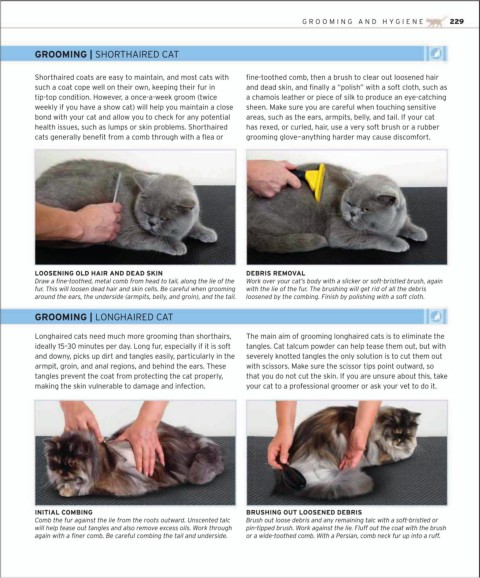
         LOOSENING OLD HAIR AND DEAD SKIN                 DEBRIS REMOVAL
         Draw a fine-toothed, metal comb from head to tail, along the lie of the   Work over your cat’s body with a slicker or soft-bristled brush, again
         fur. This will loosen dead hair and skin cells. Be careful when grooming   with the lie of the fur. The brushing will get rid of all the debris
         around the ears, the underside (armpits, belly, and groin), and the tail.  loosened by the combing. Finish by polishing with a soft cloth.

         GROOMING | LONGHAIRED CAT

         Longhaired cats need much more grooming than shorthairs,   The main aim of grooming longhaired cats is to eliminate the
         ideally 15–30 minutes per day. Long fur, especially if it is soft   tangles. Cat talcum powder can help tease them out, but with
         and downy, picks up dirt and tangles easily, particularly in the   severely knotted tangles the only solution is to cut them out
         armpit, groin, and anal regions, and behind the ears. These   with scissors. Make sure the scissor tips point outward, so
         tangles prevent the coat from protecting the cat properly,   that you do not cut the skin. If you are unsure about this, take
         making the skin vulnerable to damage and infection.   your cat to a professional groomer or ask your vet to do it.


         INITIAL COMBING                                  BRUSHING OUT LOOSENED DEBRIS
         Comb the fur against the lie from the roots outward. Unscented talc   Brush out loose debris and any remaining talc with a soft-bristled or
         will help tease out tangles and also remove excess oils. Work through   pin-tipped brush. Work against the lie. Fluff out the coat with the brush
         again with a finer comb. Be careful combing the tail and underside.  or a wide-toothed comb. With a Persian, comb neck fur up into a ruff.

