


Page 230 - The Complete Cat Breed Book (DK)
P. 230
228       C ARE AND BEHA VIOR


        GROOMING AND HYGIENE


        Cats instinctively groom themselves, spending much of
        their time keeping their fur clean, tangle-free, and conditioned.
        However, many cats, especially longhaired breeds, show cats,
        and older cats, will need some assistance from their owners.
        Helping out with basic hygiene, such as teeth cleaning and
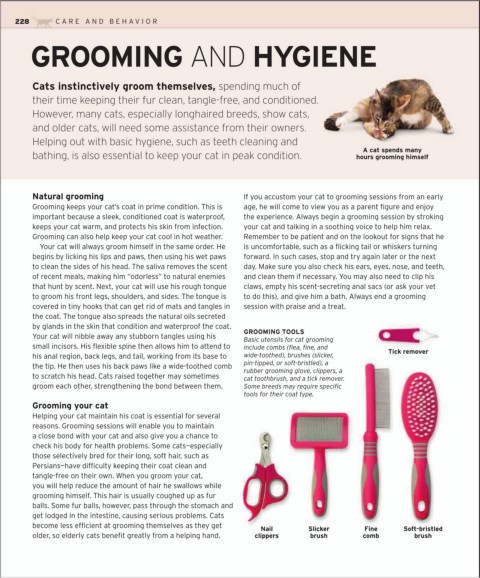
                                                                                     A cat spends many
        bathing, is also essential to keep your cat in peak condition.             hours grooming himself


        Natural grooming                                 If you accustom your cat to grooming sessions from an early
        Grooming keeps your cat’s coat in prime condition. This is   age, he will come to view you as a parent figure and enjoy
        important because a sleek, conditioned coat is waterproof,   the experience. Always begin a grooming session by stroking
        keeps your cat warm, and protects his skin from infection.   your cat and talking in a soothing voice to help him relax.
        Grooming can also help keep your cat cool in hot weather.   Remember to be patient and on the lookout for signs that he
          Your cat will always groom himself in the same order. He   is uncomfortable, such as a flicking tail or whiskers turning
        begins by licking his lips and paws, then using his wet paws   forward. In such cases, stop and try again later or the next
        to clean the sides of his head. The saliva removes the scent   day. Make sure you also check his ears, eyes, nose, and teeth,
        of recent meals, making him “odorless” to natural enemies   and clean them if necessary. You may also need to clip his
        that hunt by scent. Next, your cat will use his rough tongue   claws, empty his scent-secreting anal sacs (or ask your vet
        to groom his front legs, shoulders, and sides. The tongue is   to do this), and give him a bath. Always end a grooming
        covered in tiny hooks that can get rid of mats and tangles in   session with praise and a treat.
        the coat. The tongue also spreads the natural oils secreted
        by glands in the skin that condition and waterproof the coat.
                                                         GROOMING TOOLS
        Your cat will nibble away any stubborn tangles using his
                                                         Basic utensils for cat grooming
        small incisors. His flexible spine then allows him to attend to   include combs (flea, fine, and
        his anal region, back legs, and tail, working from its base to   wide-toothed), brushes (slicker,    Tick remover
                                                         pin-tipped, or soft-bristled), a
        the tip. He then uses his back paws like a wide-toothed comb
                                                         rubber grooming glove, clippers, a
        to scratch his head. Cats raised together may sometimes   cat toothbrush, and a tick remover.
        groom each other, strengthening the bond between them.   Some breeds may require specific
                                                         tools for their coat type.
        Grooming your cat
        Helping your cat maintain his coat is essential for several
        reasons. Grooming sessions will enable you to maintain
        a close bond with your cat and also give you a chance to
        check his body for health problems. Some cats—especially
        those selectively bred for their long, soft hair, such as
        Persians—have difficulty keeping their coat clean and
        tangle-free on their own. When you groom your cat,
        you will help reduce the amount of hair he swallows while
        grooming himself. This hair is usually coughed up as fur
        balls. Some fur balls, however, pass through the stomach and
        get lodged in the intestine, causing serious problems. Cats
        become less efficient at grooming themselves as they get
                                                             Nail       Slicker      Fine     Soft-bristled
        older, so elderly cats benefit greatly from a helping hand.  clippers  brush  comb        brush

