


Page 234 - The Complete Cat Breed Book (DK)
P. 234
232       C ARE AND BEHA VIOR


        TRAINING YOUR CAT


        Training your cat may sound like a strange, even impossible, thing
        to do and contrary to the nature of such a free-spirited animal. But
        basic training, such as teaching your cat to sit, has benefits, and
        some cats make willing pupils. Training your cat will make it easier
        for you to control and manage his behavior. You may even be able
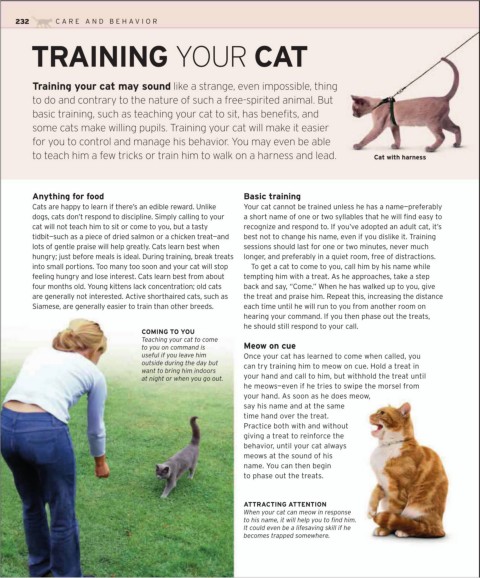
        to teach him a few tricks or train him to walk on a harness and lead.          Cat with harness


        Anything for food                                Basic training
        Cats are happy to learn if there’s an edible reward. Unlike   Your cat cannot be trained unless he has a name—preferably
        dogs, cats don’t respond to discipline. Simply calling to your   a short name of one or two syllables that he will find easy to
        cat will not teach him to sit or come to you, but a tasty   recognize and respond to. If you’ve adopted an adult cat, it’s
        tidbit—such as a piece of dried salmon or a chicken treat—and   best not to change his name, even if you dislike it. Training
        lots of gentle praise will help greatly. Cats learn best when   sessions should last for one or two minutes, never much
        hungry; just before meals is ideal. During training, break treats   longer, and preferably in a quiet room, free of distractions.
        into small portions. Too many too soon and your cat will stop   To get a cat to come to you, call him by his name while
        feeling hungry and lose interest. Cats learn best from about   tempting him with a treat. As he approaches, take a step
        four months old. Young kittens lack concentration; old cats   back and say, “Come.” When he has walked up to you, give
        are generally not interested. Active shorthaired cats, such as   the treat and praise him. Repeat this, increasing the distance
        Siamese, are generally easier to train than other breeds.  each time until he will run to you from another room on
                                                         hearing your command. If you then phase out the treats,
                                                         he should still respond to your call.
                                  COMING TO YOU
                                  Teaching your cat to come
                                  to you on command is   Meow on cue
                                  useful if you leave him   Once your cat has learned to come when called, you
                                  outside during the day but   can try training him to meow on cue. Hold a treat in
                                  want to bring him indoors
                                  at night or when you go out.  your hand and call to him, but withhold the treat until
                                                         he meows—even if he tries to swipe the morsel from
                                                         your hand. As soon as he does meow,
                                                         say his name and at the same
                                                         time hand over the treat.
                                                         Practice both with and without
                                                         giving a treat to reinforce the
                                                         behavior, until your cat always
                                                         meows at the sound of his
                                                         name. You can then begin
                                                         to phase out the treats.


                                                         ATTRACTING ATTENTION
                                                         When your cat can meow in response
                                                         to his name, it will help you to find him.
                                                         It could even be a lifesaving skill if he
                                                         becomes trapped somewhere.

