


Page 27 - (DK Eyewitness) Travel Guide - Southwest USA & National Parks
P. 27
A POR TR AIT OF THE SOUTHWEST 25
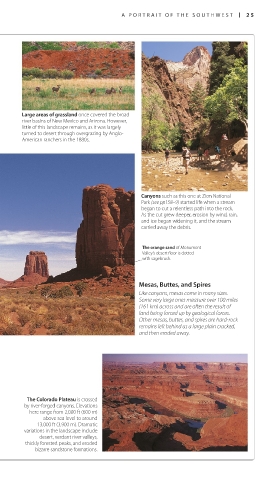
Large areas of grassland once covered the broad
river basins of New Mexico and Arizona. However,
little of this landscape remains, as it was largely
turned to desert through overgrazing by Anglo-
American ranchers in the 1880s.
Canyons such as this one at Zion National
Park (see pp158–9) started life when a stream
began to cut a relentless path into the rock.
As the cut grew deeper, erosion by wind, rain,
and ice began widening it, and the stream
carried away the debris.
The orange sand of Monument
Valley’s desert floor is dotted
with sagebrush.
Mesas, Buttes, and Spires
Like canyons, mesas come in many sizes.
Some very large ones measure over 100 miles
(161 km) across and are often the result of
land being forced up by geological forces.
Other mesas, buttes, and spires are hard-rock
remains left behind as a large plain cracked,
and then eroded away.
The Colorado Plateau is crossed
by river-forged canyons. Elevations
here range from 2,000 ft (600 m)
above sea level to around
13,000 ft (3,900 m). Dramatic
variations in the landscape include
desert, verdant river valleys,
thickly forested peaks, and eroded
bizarre sandstone formations.
024-025_EW_SW_USA.indd 25 28/11/17 12:39 PM

