


Page 28 - (DK Eyewitness) Travel Guide - Southwest USA & National Parks
P. 28
26 INTRODUCING THE SOUTHWEST A POR TR AIT OF THE SOUTHWEST 27
Desert Flora and Fauna Dangers in the Desert
Despite the fact that around 70 percent of the Southwest region is The danger of poisonous desert creatures has often been
occupied by desert, it is not an arid, lifeless wasteland. There are four exaggerated. Although some desert creatures do, on rare
occasions, bite or sting people, the bites are seldom fatal
distinct deserts: the Sonoran, the Chihuahuan, the Great Basin, and unless the victims are small children or have serious health
the Mojave. The Sonoran Desert has one of the richest arrays of flora problems. To avoid being hurt, never reach into dark spaces
and fauna in the country. The Chihuahuan Desert supports hardy or up onto overhead ledges where you can’t see. Watch where
yuccas and agaves, and its hills and plains are covered with a dry, you place your feet, and shake out clothes and shoes before
putting them on. Never harass or handle a poisonous creature.
wheat-colored grass. The Great Basin is a cooler desert and home to If you are bitten, stay calm and seek medical help immediately.
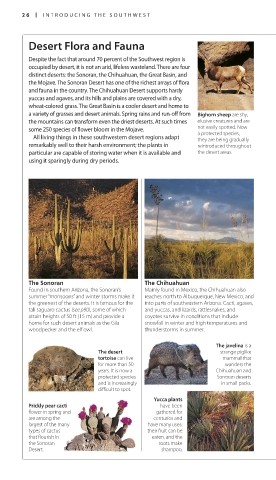
a variety of grasses and desert animals. Spring rains and run-off from Bighorn sheep are shy,
the mountains can transform even the driest deserts. At such times elusive creatures and are
some 250 species of flower bloom in the Mojave. not easily spotted. Now The desert scorpion is The Gila monster is the only
a protected species,
veno mous lizard in the US. It is
All living things in these southwestern desert regions adapt they are being gradually golden in color. Its bite is a slow-moving but rarely seen
remarkably well to their harsh environment; the plants in reintroduced throughout venomous, so anyone who inhabitant of the desert regions,
particular are capable of storing water when it is available and the desert areas. has been bitten should go to and will only bite if it feels
using it sparingly during dry periods. a hospital for an antidote. threatened.
The Sonoran The Chihuahuan The Great Basin The Mojave
Found in southern Arizona, the Sonoran’s Mainly found in Mexico, the Chihuahuan also With its canyons, cliffs, mesas, and buttes, the This vast desert extends into central and
summer “monsoons” and winter storms make it reaches north to Albuquerque, New Mexico, and landscape of the Great Basin Desert appears northern Arizona. The Mojave is dry for most
the greenest of the deserts. It is famous for the into parts of southeastern Arizona. Cacti, agaves, most characteristic of the region. It extends from of the year, but a small amount of winter rain
tall saguaro cactus (see p90), some of which and yuccas, and lizards, rattlesnakes, and the far northwest corner of Arizona into eastern results in a display of wild flowers in spring.
attain heights of 50 ft (15 m) and provide a coyotes survive in conditions that include Utah and Oregon, and its scattering of cacti, Other flora and fauna found here include
home for such desert animals as the Gila snowfall in winter and high temperatures and sage, and mesquite is home to the bighorn creosote bush, cacti, yucca, jackrabbits, desert
woodpecker and the elf owl. thunderstorms in summer. sheep and various types of rattlesnake. tortoises, and bighorn sheep.
The javelina is a Sagebrush is
The desert strange piglike a pervasive The blacktailed jackrabbit is born
tortoise can live mammal that subshrub that with a full coat of muted fur to
for more than 50 wanders the covers vast areas camouflage it from predators
years. It is now a Chihuahuan and of the cooler such as the coyote.
protected species Sonoran deserts Great Basin
and is increasingly in small packs. Desert. It smells
difficult to spot. of sage.
Yucca plants
Prickly pear cacti have been
flower in spring and gathered for
are among the centuries and
largest of the many have many uses:
types of cactus their fruit can be Golden eagles can be seen The Joshua tree was
that flourish in eaten, and the high in the sky in daytime as named by Mormons who
the Sonoran roots make they hunt for prey across pictured the upraised arms
Desert. shampoo. the Great Basin Desert. of Joshua in its branches.
026-027_EW_SW_USA.indd 26 28/11/17 12:39 PM 026-027_EW_SW_USA.indd 27 28/11/17 12:39 PM
Eyewitness Travel LAYERS PRINTED:
Feature template “UK” LAYER
(SourceReport v1.3)
Date 18th October 2012
Size 125mm x 217mm

