


Page 30 - (DK Eyewitness) Travel Guide - Southwest USA & National Parks
P. 30
28 INTRODUCING THE SOUTHWEST A POR TR AIT OF THE SOUTHWEST 29
Architecture of the Southwest Mission Revival
The history of architecture in the Southwest reaches back to Similar in spirit to Spanish Colonial trends, the early 20th-century
the Ancestral Puebloan or Anasazi builders of the pueblos of Mission Revival style is characterized by stucco walls made of white
Chaco Canyon (see pp178–9), demonstrating skilled craftsman lime cement, often with graceful arches, flat roofs, and courtyards,
but with less ornamentation. A fine example of a Mission Revival-
ship. Across the region, his toric architecture can be seen in style bungalow is the J. Knox Corbett House in Tucson’s Historic
many towns and cities, with the adobes of their oldtown District (see p88). Built of brick but plastered over in white to simulate
districts arranged around a central plaza. But there are also adobe, it has a red-tile roof and a big screen porch at the back. Façade of the J. Knox Corbett House
other architectural styles, from the Spanish Colonial of the White plaster
18th century to those of the 19th and early 20th century. Red-tiled roof
Wooden storefronts, Victorian mansions, and miners’ cottages
all lend a rustic charm to many mountain towns, and one of J. Knox Corbett
the 20th century’s most famous architects, Frank Lloyd Wright, San Felipe de Neri Church, House in Tuscon
set up an architectural school in Scottsdale (see p85). Albuquerque Old Town was designed in
the popular Mission
Revival style by the
Traditional Adobe Chicago architect
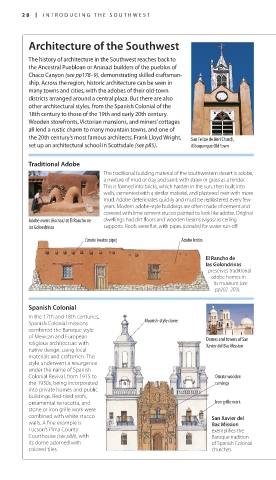
The traditional building material of the southwestern desert is adobe, David Holmes
a mixture of mud or clay and sand, with straw or grass as a binder. in 1906.
This is formed into bricks, which harden in the sun, then built into
walls, cemented with a similar material, and plastered over with more Pueblo Revival
mud. Adobe deteriorates quickly and must be replastered every few
years. Modern adobe-style buildings are often made of cement and Pueblo Revival was another southwestern style that became
particularly fashionable in the first three decades of the 20th
covered with lime cement stucco painted to look like adobe. Original
Adobe ovens (hornos) at El Rancho de dwellings had dirt floors and wooden beams (vigas) as ceiling century. It featured adobe or simulated adobe walls, with
projecting vigas (wooden beams), and flat roofs with canales
las Golondrinas supports. Roofs were flat, with pipes (canales) for water run-off.
(jutting water spouts). The second and third stories were usually
set back to resemble multistory pueblo dwellings, such as Taos
Canale (water pipe) Adobe bricks
Pueblo (see p210), hence the name. Features include rounded
New Mexico Museum of Art in Santa Fe parapets, framed portal windows, and wood columns. This style
El Rancho de has been used frequently in public buildings; the New Mexico
las Golondrinas Museum of Art in Santa Fe (see p198) is an outstanding example.
preserves traditional
adobe homes in Framed portal Rounded parapet
its museum (see window Flat roof
pp202–203).
Spanish Colonial
In the 17th and 18th centuries,
Spanish Colonial missions Moorish-style dome
combined the Baroque style
of Mexican and European Domes and towers of San The New Mexico Museum of Art in Santa Fe was built in 1917 and
religious architecture with Xavier del Bac Mission was the first building in Pueblo Revival style in the city. A central
native design, using local courtyard providing shade from the sun is one of its features. Adobe wall
materials and craftsmen. This
style underwent a resurgence
under the name of Spanish Contemporary Architecture
Colonial Revival, from 1915 to Ornate wooden
the 1930s, being incorporated carvings Two of America’s most prominent architects, Frank Lloyd
into private homes and public Wright (1867–1959) and Paolo Soleri (1919–2013), practiced
buildings. Red-tiled roofs, in the Southwest. Wright’s “organic architecture” advocated
ornamental terracotta, and Iron grille work the use of local materials and the importance of the setting.
stone or iron grille work were His architectural complex at Taliesin West (see p85) included
combined with white stucco San Xavier del a school, offices, and his home. It was built from desert stones
and sand, and the expansive proportions reflect the Arizona
walls. A fine example is Bac Mission desert. In the 1940s, Italian Soleri studied at Taliesin. In 1956
Tucson’s Pima County exemplifies the he established the Cosanti Foundation (see p85) devoted
Courthouse (see p88), with Baroque tradition to “arcology,” a synthesis of architecture and ecology that Interior of Taliesin West, designed by
its dome adorned with of Spanish Colonial minimizes the waste of energy endemic in modern towns. Frank Lloyd Wright
colored tiles. churches.
028-029_EW_SW_USA.indd 28 28/11/17 12:39 PM 028-029_EW_SW_USA.indd 29 28/11/17 12:39 PM
Eyewitness Travel LAYERS PRINTED:
Feature template “UK” LAYER
(SourceReport v1.3)
Date 18th October 2012
Size 125mm x 217mm

