


Page 31 - (DK Eyewitness) Travel Guide - Southwest USA & National Parks
P. 31
A POR TR AIT OF THE SOUTHWEST 29
Mission Revival
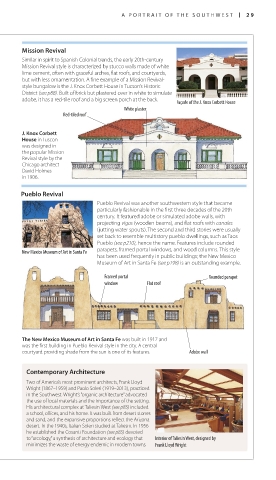
Similar in spirit to Spanish Colonial trends, the early 20th-century
Mission Revival style is characterized by stucco walls made of white
lime cement, often with graceful arches, flat roofs, and courtyards,
but with less ornamentation. A fine example of a Mission Revival-
style bungalow is the J. Knox Corbett House in Tucson’s Historic
District (see p88). Built of brick but plastered over in white to simulate
adobe, it has a red-tile roof and a big screen porch at the back. Façade of the J. Knox Corbett House
White plaster
Red-tiled roof
J. Knox Corbett
House in Tuscon
was designed in
the popular Mission
Revival style by the
Chicago architect
David Holmes
in 1906.
Pueblo Revival
Pueblo Revival was another southwestern style that became
particularly fashionable in the first three decades of the 20th
century. It featured adobe or simulated adobe walls, with
projecting vigas (wooden beams), and flat roofs with canales
(jutting water spouts). The second and third stories were usually
set back to resemble multistory pueblo dwellings, such as Taos
Pueblo (see p210), hence the name. Features include rounded
New Mexico Museum of Art in Santa Fe parapets, framed portal windows, and wood columns. This style
has been used frequently in public buildings; the New Mexico
Museum of Art in Santa Fe (see p198) is an outstanding example.
Framed portal Rounded parapet
window Flat roof
The New Mexico Museum of Art in Santa Fe was built in 1917 and
was the first building in Pueblo Revival style in the city. A central
courtyard providing shade from the sun is one of its features. Adobe wall
Contemporary Architecture
Two of America’s most prominent architects, Frank Lloyd
Wright (1867–1959) and Paolo Soleri (1919–2013), practiced
in the Southwest. Wright’s “organic architecture” advocated
the use of local materials and the importance of the setting.
His architectural complex at Taliesin West (see p85) included
a school, offices, and his home. It was built from desert stones
and sand, and the expansive proportions reflect the Arizona
desert. In the 1940s, Italian Soleri studied at Taliesin. In 1956
he established the Cosanti Foundation (see p85) devoted
to “arcology,” a synthesis of architecture and ecology that Interior of Taliesin West, designed by
minimizes the waste of energy endemic in modern towns. Frank Lloyd Wright
028-029_EW_SW_USA.indd 29 28/11/17 12:39 PM

