


Page 105 - (DK) Help Your Kids with Language Arts
P. 105
103
                                                                                     CO LO N S


          REAL  W OR L D
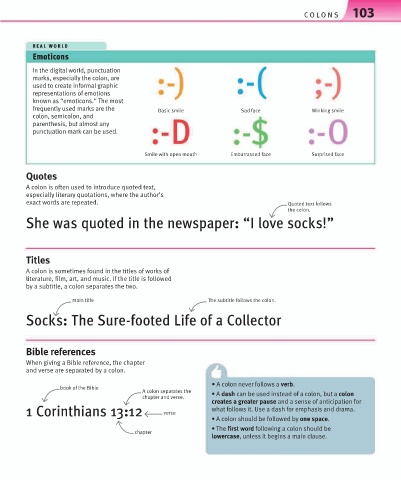
          Emoticons

          In the digital world, punctuation
          marks, especially the colon, are
          used to create informal graphic
          representations of emotions
          known as “emoticons.” The most
          frequently used marks are the      Basic smile           Sad face            Winking smile
          colon, semicolon, and
          parenthesis, but almost any
          punctuation mark can be used.


                                         Smile with open mouth   Embarrassed face      Surprised face


        Quotes
        A colon is often used to introduce quoted text,
        especially literary quotations, where the author’s
        exact words are repeated.                                               Quoted text follows
                                                                                the colon.
        She was quoted in the newspaper: “I love socks!”


        Titles
        A colon is sometimes found in the titles of works of
        literature, film, art, and music. If the title is followed
        by a subtitle, a colon separates the two.
                     main title                           The subtitle follows the colon.

        Socks: The Sure-footed Life of a Collector


        Bible references
        When giving a Bible reference, the chapter
        and verse are separated by a colon.

                                                           • A colon never follows a verb.
                  book of the Bible
                                        A colon separates the    • A dash can be used instead of a colon, but a colon
                                        chapter and verse.
                                                           creates a greater pause and a sense of anticipation for
        1 Corinthians 13:12                   verse        what follows it. Use a dash for emphasis and drama.
                                                           • A colon should be followed by one space.
                                                           • The first word following a colon should be
                                      chapter
                                                           lowercase, unless it begins a main clause.

