


Page 41 - (DK) Help Your Kids with Language Arts
P. 41
39
                                                                                       VERBS


        Linking verbs

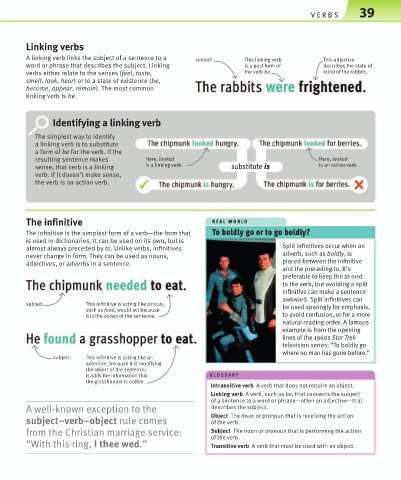
        A linking verb links the subject of a sentence to a   subject  This linking verb    This adjective
        word or phrase that describes the subject. Linking          is a past form of     describes the state of
        verbs either relate to the senses (feel, taste,             the verb be.          mind of the rabbits.
        smell, look, hear) or to a state of existence (be,
        become, appear, remain). The most common
        linking verb is be.


                Identifying a linking verb

           The simplest way to identify
           a linking verb is to substitute
           a form of be for the verb. If the
           resulting sentence makes      Here, looked                                    Here, looked
           sense, that verb is a linking   is a linking verb.    substitute is           is an action verb.
           verb. If it doesn’t make sense,
           the verb is an action verb.


        The infinitive                                       REAL  W OR L D
        The infinitive is the simplest form of a verb—the form that   To boldly go or to go boldly?
        is used in dictionaries. It can be used on its own, but is
        almost always preceded by to. Unlike verbs, infinitives                 Split infinitives occur when an
        never change in form. They can be used as nouns,                       adverb, such as boldly, is
        adjectives, or adverbs in a sentence.                                  placed between the infinitive
                                                                               and the preceding to. It’s
                                                                               preferable to keep the to next
                                                                               to the verb, but avoiding a split
                                                                               infinitive can make a sentence
                                                                               awkward. Split infinitives can
        subject          This infinitive is acting like a noun,                 be used sparingly for emphasis,
                         such as food, would act because
                         it is the object of the sentence.                     to avoid confusion, or for a more
                                                                               natural reading order. A famous
                                                                               example is from the opening
                                                                               lines of the 1960s Star Trek
                                                                               television series: “To boldly go
                                                                               where no man has gone before.”
                subject  This infinitive is acting like an
                         adjective, because it is modifying
                         the object of the sentence;
                         it adds the information that      GLO S S A RY
                         the grasshopper is edible.
                                                           Intransitive verb  A verb that does not require an object.
                                                           Linking verb  A verb, such as be, that connects the subject
                                                           of a sentence to a word or phrase—often an adjective—that
        A well-known exception to the                      describes the subject.
                                                           Object  The noun or pronoun that is receiving the action
        subject–verb–object rule comes                     of the verb.
        from the Christian marriage service:               Subject  The noun or pronoun that is performing the action
                                                           of the verb.
        “With this ring, I thee wed.”                      Transitive verb  A verb that must be used with an object.

