


Page 51 - (DK) Help Your Kids with Language Arts
P. 51
49
                                                                         A UXILIARY  VERBS


        Primary auxiliary verbs
        The verbs be, have, and do are known as the primary
        auxiliary verbs. Primary auxiliary verbs can be used as the         • Only the primary auxiliaries—be,
        main verb in a sentence, or they can be used with participles       have, and do—can change their
        to form tenses. These verbs also have participles of their          form. Modal auxiliaries always take
        own. Auxiliary verbs are irregular verbs, and are irregular         the same form.
        even in the present tense.                                          • Might is the past tense of may,
                                                                            so might is always used when
                                                                            talking about something that might
         Verb form                   be         have        do              have happened previously.
                                                                            • Sometimes modal auxiliaries are
         Infinitive                   be         have        do
                                                                            used to add emphasis to a decision
         First person (present)      am, are    have        do              or a command. Using will instead
         Second person (present)     are        have        do              of am going to for the first person
                                                                            future tense makes a statement
         Third person (present)      is, are    has, have   does, do
                                                                            sound more determined: for
         Past participle             been       had         done            example, “I will go to the party.”
         Present participle          being      having      doing


        Modal auxiliary verbs
        Common auxiliary verbs that cannot    or a possibility. Modal auxiliaries are
        be used on their own are known as   unusual because they do not have
        modal auxiliary verbs. These include   an infinitive form or participles, nor—
        can, will, should, may, and must, and   unlike primary auxiliaries and regular
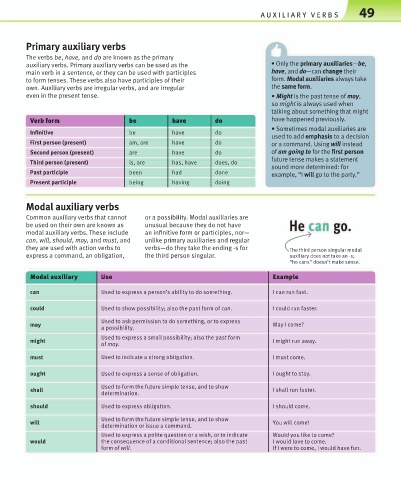
        they are used with action verbs to   verbs—do they take the ending -s for   The third person singular modal
        express a command, an obligation,    the third person singular.          auxiliary does not take an -s;
                                                                                 “he cans” doesn’t make sense.
         Modal auxiliary     Use                                            Example

         can                 Used to express a person’s ability to do something.  I can run fast.

         could               Used to show possibility; also the past form of can.  I could run faster.
                             Used to ask permission to do something, or to express
         may                                                                May I come?
                             a possibility.
                             Used to express a small possibility; also the past form
         might                                                              I might run away.
                             of may.
         must                Used to indicate a strong obligation.          I must come.

         ought               Used to express a sense of obligation.         I ought to stay.
                             Used to form the future simple tense, and to show
         shall                                                              I shall run faster.
                             determination.
         should              Used to express obligation.                    I should come.
                             Used to form the future simple tense, and to show
         will                                                               You will come!
                             determination or issue a command.
                             Used to express a polite question or a wish, or to indicate    Would you like to come?
         would               the consequence of a conditional sentence; also the past    I would love to come.
                             form of will.                                  If I were to come, I would have fun.

