


Page 50 - (DK) Help Your Kids with Language Arts
P. 50
48 GRAMMAR
Auxiliary verbs SEE ALSO
34–35 Pronouns
SOME VERBS HELP TO FORM OTHER VERBS. 38–39 Verbs
42–43 Simple tenses
Often called “helping verbs,” auxiliary verbs can be used in front 44–45 Perfect and continuous tenses
46–47 Participles
of other verbs to form tenses, negative sentences, and the passive
Voices and moods 54–55
voice, or to express different moods. Negatives 80–81
Question marks 110–111
Helpful properties Must is the only verb in English to
Auxiliary verbs are known as helping verbs because they have a present but no past form.
perform several different roles. Their main job is to help
form different tenses, but they are also used to create
negative sentences, turn statements into questions, and
add emphasis to speech.
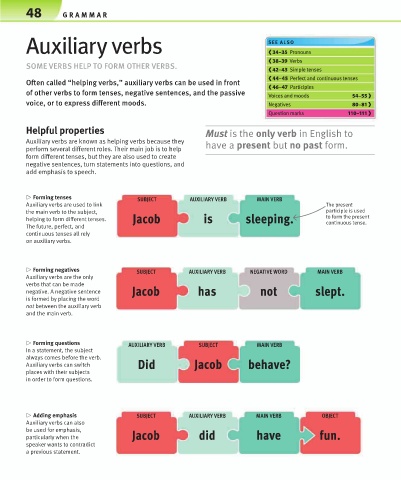
▷ Forming tenses SUBJECT AUXILIARY VERB MAIN VERB
Auxiliary verbs are used to link The present
the main verb to the subject, participle is used
helping to form different tenses. Jacob is sleeping. to form the present
continuous tense.
The future, perfect, and
continuous tenses all rely
on auxiliary verbs.
▷ Forming negatives SUBJECT AUXILIARY VERB NEGATIVE WORD MAIN VERB
Auxiliary verbs are the only
verbs that can be made
negative. A negative sentence Jacob has not slept.
is formed by placing the word
not between the auxiliary verb
and the main verb.
▷ Forming questions AUXILIARY VERB SUBJECT MAIN VERB
In a statement, the subject
always comes before the verb.
Auxiliary verbs can switch Did Jacob behave?
places with their subjects
in order to form questions.
▷ Adding emphasis SUBJECT AUXILIARY VERB MAIN VERB OBJECT
Auxiliary verbs can also
be used for emphasis,
particularly when the Jacob did have fun.
speaker wants to contradict
a previous statement.

