


Page 64 - (DK) Help Your Kids with Language Arts
P. 64
62 GRAMMAR
Interjections SEE ALSO
20–21 Parts of speech
Sentences 68–69
INTERJECTIONS ARE WORDS OR PHRASES THAT
Colloquialisms and slang 86–87
OCCUR ALONE AND EXPRESS EMOTION. Commas 96–99
Exclamation points 112–113
Interjections are considered a part of speech, but they play no
grammatical role in a sentence. They are single words or phrases
that are used to exclaim, protest, or command, and rarely appear
in formal writing.
Emotional words Using interjections
Interjections occur frequently in spoken English. They are Interjections that express strong emotions such as
useful in informal writing—particularly in narratives or dismay or surprise usually function as exclamations,
scripts—since they help convey the emotions of a character, appearing alone as single words or phrases followed
but they are only used in formal writing as part of a direct by an exclamation point. Milder emotions tend to be
quotation. New interjections to describe different emotions expressed using an interjection followed by a comma.
are invented all the time, and they vary from region to region.
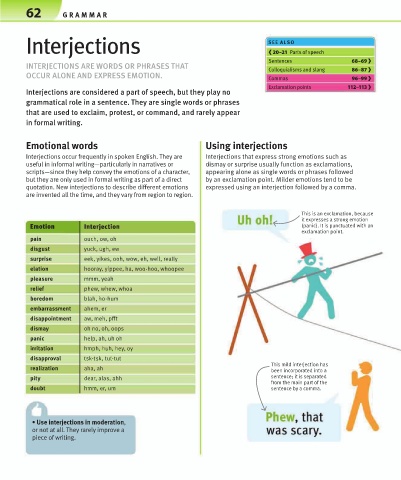
This is an exclamation, because
it expresses a strong emotion
Emotion Interjection (panic). It is punctuated with an
exclamation point.
pain ouch, ow, oh
disgust yuck, ugh, ew
surprise eek, yikes, ooh, wow, eh, well, really
elation hooray, yippee, ha, woo-hoo, whoopee
pleasure mmm, yeah
relief phew, whew, whoa
boredom blah, ho-hum
embarrassment ahem, er
disappointment aw, meh, pfft
dismay oh no, oh, oops
panic help, ah, uh oh
irritation hmph, huh, hey, oy
disapproval tsk-tsk, tut-tut
This mild interjection has
realization aha, ah been incorporated into a
pity dear, alas, ahh sentence; it is separated
from the main part of the
doubt hmm, er, um sentence by a comma.
• Use interjections in moderation,
or not at all. They rarely improve a
piece of writing.

