


Page 65 - (DK) Help Your Kids with Language Arts
P. 65
63
                                                                            INTERJE CTIONS


                                                          Interruptions and introductions
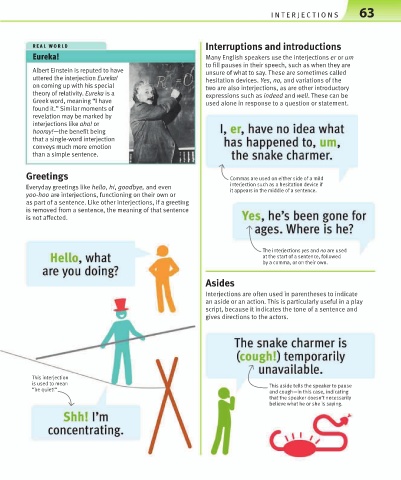
          REAL  W OR L D
          Eureka!                                         Many English speakers use the interjections er or um
                                                          to fill pauses in their speech, such as when they are
          Albert Einstein is reputed to have              unsure of what to say. These are sometimes called
          uttered the interjection Eureka!                hesitation devices. Yes, no, and variations of the
          on coming up with his special                   two are also interjections, as are other introductory
          theory of relativity. Eureka is a               expressions such as indeed and well. These can be
          Greek word, meaning “I have                     used alone in response to a question or statement.
          found it.” Similar moments of
          revelation may be marked by
          interjections like aha! or
          hooray!—the benefit being
          that a single-word interjection
          conveys much more emotion
          than a simple sentence.


        Greetings                                               Commas are used on either side of a mild
                                                                interjection such as a hesitation device if
        Everyday greetings like hello, hi, goodbye, and even    it appears in the middle of a sentence.
        yoo-hoo are interjections, functioning on their own or
        as part of a sentence. Like other interjections, if a greeting
        is removed from a sentence, the meaning of that sentence
        is not affected.


                                                                         The interjections yes and no are used
                                                                         at the start of a sentence, followed
                                                                         by a comma, or on their own.

                                                          Asides
                                                          Interjections are often used in parentheses to indicate
                                                          an aside or an action. This is particularly useful in a play
                                                          script, because it indicates the tone of a sentence and
                                                          gives directions to the actors.


          This interjection
          is used to mean                                                  This aside tells the speaker to pause
          “be quiet!”
                                                                           and cough—in this case, indicating
                                                                           that the speaker doesn’t necessarily
                                                                           believe what he or she is saying.

