


Page 136 - (DK) Ocean - The Definitive Visual Guide
P. 136
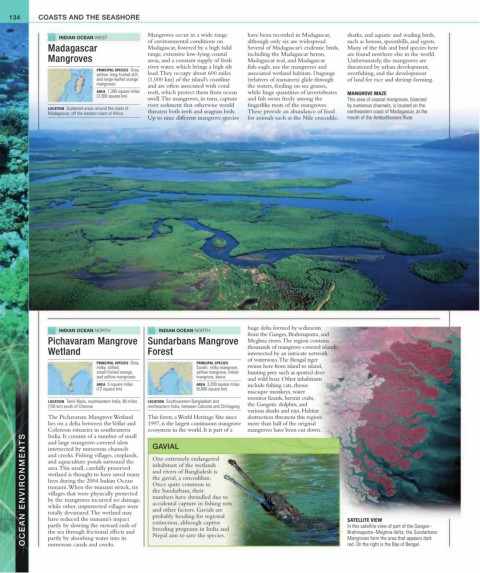
134     COASTS AND THE SEASHORE


                  INDIAN OCEAN WEST          Mangroves occur in a wide range    have been recorded in Madagascar,   sharks, and aquatic and wading birds,
                                             of environmental conditions on   although only six are widespread.   such as herons, spoonbills, and egrets.
               Madagascar                    Madagascar, fostered by a high tidal   Several of Madagascar’s endemic birds,   Many of the fish and bird species here
                                             range, extensive low-lying coastal   including the Madagascar heron,   are found nowhere else in the world.
               Mangroves                     areas, and a constant supply of fresh   Madagascar teal, and Madagascar    Unfortunately, the mangroves are
                                             river water, which brings a high silt   fish-eagle, use the mangroves and   threatened by urban development,
                              PRINCIPAL SPECIES  Gray,
                              yellow, long-fruited stilt,   load. They occupy about 600 miles   associated wetland habitats. Dugongs   overfishing, and the development
                              and large-leafed orange   (1,000 km) of the island’s coastline   (relatives of manatees) glide through   of land for rice and shrimp farming.
                              mangroves      and are often associated with coral   the waters, feeding on sea grasses,
                              AREA  1,300 square miles   reefs, which protect them from ocean   while huge quantities of invertebrates   MANGROVE MAZE
                              (3,300 square km)
                                             swell. The mangroves, in turn, capture   and fish swim freely among the   This area of coastal mangroves, bisected
                                             river sediment that otherwise would   fingerlike roots of the mangroves.   by numerous channels, is located on the
               LOCATION  Scattered areas around the coast of
               Madagascar, off the eastern coast of Africa  threaten both reefs and seagrass beds.   These provide an abundance of food   northeastern coast of Madagascar, at the
                                             Up to nine different mangrove species   for animals such as the Nile crocodile,   mouth of the Ambodibonara River.


                  INDIAN OCEAN NORTH            INDIAN OCEAN NORTH         huge delta formed by sediments
                                                                           from the Ganges, Brahmaputra, and
               Pichavaram Mangrove  Sundarbans Mangrove                    Meghna rivers. The region contains
                                                                           thousands of mangrove-covered islands
               Wetland                       Forest                        intersected by an intricate network
                                                                           of waterways. The Bengal tiger
                              PRINCIPAL SPECIES  Gray,     PRINCIPAL SPECIES
                              milky, stilted,              Sundri, milky mangrove,   swims here from island to island,
                              small-fruited orange,        yellow mangrove, Indian   hunting prey such as spotted deer
                              and yellow mangroves         mangrove, keora   and wild boar. Other inhabitants
                              AREA  5 square miles         AREA  3,200 square miles   include fishing cats, rhesus
                              (12 square km)               (8,000 square km)
                                                                           macaque monkeys, water
                                                                           monitor lizards, hermit crabs,
               LOCATION  Tamil Nadu, southeastern India, 90 miles   LOCATION  Southwestern Bangladesh and
               (150 km) south of Chennai     northeastern India, between Calcutta and Chittagong   the Gangetic dolphin, and
                                                                           various sharks and rays. Habitat
               The Pichavaram Mangrove Wetland   This forest, a World Heritage Site since   destruction threatens this region:
               lies on a delta between the Vellar and   1997, is the largest continuous mangrove  more than half of the original
               Coleroon estuaries in southeastern   ecosystem in the world. It is part of a   mangroves have been cut down.
               India. It consists of a number of small
        OCEAN ENVIRONMENTS  and aquaculture ponds surround the   inhabitant of the wetlands             SATELLITE VIEW
               and large mangrove-covered islets
                                              GAVIAL
               intersected by numerous channels
               and creeks. Fishing villages, croplands,
                                              One extremely endangered
               area. This small, carefully preserved
                                              and rivers of Bangladesh is
               wetland is thought to have saved many
                                              the gavial, a crocodilian.
               lives during the 2004 Indian Ocean
                                              Once quite common in
               tsunami. When the tsunami struck, six
                                              the Sundarbans, their
               villages that were physically protected
                                              numbers have dwindled due to
               by the mangroves incurred no damage,
                                              accidental capture in fishing nets
               while other, unprotected villages were
                                              and other factors. Gavials are
               totally devastated. The wetland may
                                              probably heading for regional
               have reduced the tsunami’s impact
                                              extinction, although captive
               partly by slowing the onward rush of
                                                                                                        In this satellite view of part of the Ganges–
                                              breeding programs in India and
               the sea through frictional effects and
                                                                                                        Brahmaputra–Meghna delta, the Sundarbans
                                              Nepal aim to save the species.
               partly by absorbing water into its
                                                                                                        Mangroves form the area that appears dark
                                                                                                        red. On the right is the Bay of Bengal.
               numerous canals and creeks.

