


Page 132 - (DK) Ocean - The Definitive Visual Guide
P. 132
130     COASTS AND THE SEASHORE


               Mangrove Swamps


               A MANGROVE SWAMP IS A COLLECTION of salt-tolerant evergreen trees, thriving in
               an intertidal environment in the tropics or subtropics. Mangrove swamps line about
               eight percent of the world’s coastlines, where they filter pollutants
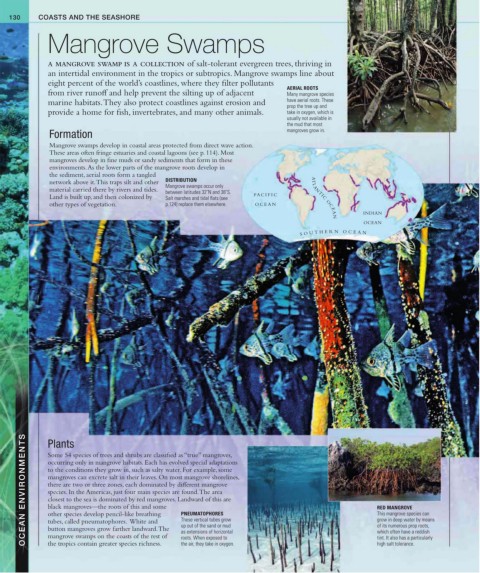
                                                                                      AERIAL ROOTS
               from river runoff and help prevent the silting up of adjacent          Many mangrove species
               marine habitats. They also protect coastlines against erosion and      have aerial roots. These
                                                                                      prop the tree up and
               provide a home for fish, invertebrates, and many other animals.        take in oxygen, which is
                                                                                      usually not available in
                                                                                      the mud that most
                Formation                                                             mangroves grow in.
                Mangrove swamps develop in coastal areas protected from direct wave action.
                These areas often fringe estuaries and coastal lagoons (see p. 114). Most
                mangroves develop in fine muds or sandy sediments that form in these
                environments. As the lower parts of the mangrove roots develop in
                the sediment, aerial roots form a tangled
                network above it. This traps silt and other   DISTRIBUTION
                                                  Mangrove swamps occur only
                material carried there by rivers and tides.
                                                  between latitudes 32˚N and 38˚S.
                Land is built up, and then colonized by   Salt marshes and tidal flats (see   PA CIFIC   ATLANTIC OCEAN
                other types of vegetation.        p.124) replace them elsewhere.   OCEAN
                                                                                                             INDIAN
                                                                                                             OCEAN
                                                                                          S O U T H E R N   O C E A N


        OCEAN ENVIRONMENTS  Plants                     PNEUMATOPHORES                                            RED MANGROVE

               Some 54 species of trees and shrubs are classified as “true” mangroves,
               occurring only in mangrove habitats. Each has evolved special adaptations
               to the conditions they grow in, such as salty water. For example, some
               mangroves can excrete salt in their leaves. On most mangrove shorelines,
               there are two or three zones, each dominated by different mangrove
               species. In the Americas, just four main species are found. The area
               closest to the sea is dominated by red mangroves. Landward of this are
               black mangroves—the roots of this and some
               other species develop pencil-like breathing
                                                                                                                 This mangrove species can
                                                                                                                 grow in deep water by means
                                                       These vertical tubes grow
               tubes, called pneumatophores.  White and
                                                                                                                 of its numerous prop roots,
                                                       up out of the sand or mud
               button mangroves grow farther landward. The
                                                                                                                 which often have a reddish
                                                       as extensions of horizontal
               mangrove swamps on the coasts of the rest of
                                                                                                                 tint. It also has a particularly
                                                       roots. When exposed to
               the tropics contain greater species richness.
                                                                                                                 high salt tolerance.
                                                       the air, they take in oxygen.

