


Page 133 - (DK) Ocean - The Definitive Visual Guide
P. 133
131


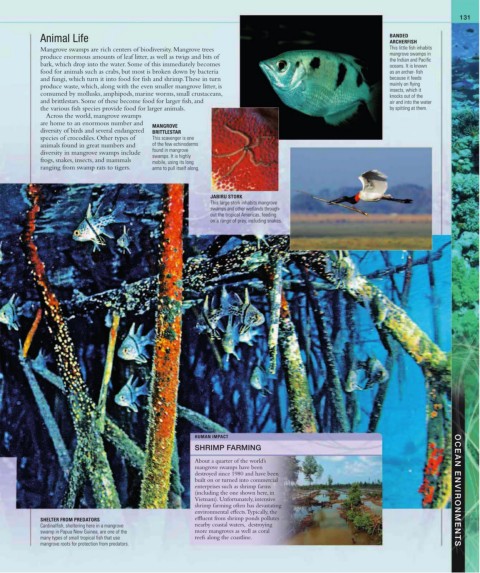
             Animal Life                                                                                             BANDED
                                                                                                                     ARCHERFISH
             Mangrove swamps are rich centers of biodiversity. Mangrove trees                                        This little fish inhabits
             produce enormous amounts of leaf litter, as well as twigs and bits of                                   mangrove swamps in
                                                                                                                     the Indian and Pacific
             bark, which drop into the water. Some of this immediately becomes                                       oceans. It is known
             food for animals such as crabs, but most is broken down by bacteria                                     as an archer- fish
             and fungi, which turn it into food for fish and shrimp. These in turn                                   because it feeds
             produce waste, which, along with the even smaller mangrove litter, is                                   mainly on flying
                                                                                                                     insects, which it
             consumed by mollusks, amphipods, marine worms, small crustaceans,                                       knocks out of the
             and brittlestars. Some of these become food for larger fish, and                                        air and into the water
             the various fish species provide food for larger animals.                                               by spitting at them.
               Across the world, mangrove swamps
             are home to an enormous number and   MANGROVE
             diversity of birds and several endangered   BRITTLESTAR
             species of crocodiles. Other types of   This scavenger is one
             animals found in great numbers and   of the few echinoderms
             diversity in mangrove swamps include   found in mangrove
                                              swamps. It is highly
             frogs, snakes, insects, and mammals   mobile, using its long
             ranging from swamp rats to tigers.  arms to pull itself along.


                                                                JABIRU STORK
                                                                This large stork inhabits mangrove
                                                                swamps and other wetlands through-
                                                                out the tropical Americas, feeding
                                                                on a range of prey, including snakes.


                                                           HUMAN IMPACT
                                                           SHRIMP FARMING

                                                           About a quarter of the world’s
                                                           mangrove swamps have been
                                                           destroyed since 1980 and have been
                                                           built on or turned into commercial
                                                           enterprises such as shrimp farms
                                                           (including the one shown here, in                                             OCEAN ENVIRONMENTS
                                                           Vietnam). Unfortunately, intensive
                                                           shrimp farming often has devastating
                                                           environmental effects. Typically, the
             SHELTER FROM PREDATORS                        effluent from shrimp ponds pollutes
             Cardinalfish, sheltering here in a mangrove    nearby coastal waters,  destroying
             swamp in Papua New Guinea, are one of the     more mangroves as well as coral
             many types of small tropical fish that use     reefs along the coastline.
             mangrove roots for protection from predators.

