


Page 131 - (DK) Ocean - The Definitive Visual Guide
P. 131
129


                PACIFIC OCEAN NORTHWEST                                                                  PACIFIC OCEAN NORTHWEST
             Saemangeum                                                                               Yatsu-Higata
             Wetlands                                                                                 Tidal Flat

                           TYPE                                                                                      TYPE
                           Mudflats, sandflats, and                                                                    Tidal mudflat
                           salt marshes
                                                                                                                     AREA
                           AREA                                                                                      1 / 6  square mile
                           155 square miles                                                                          (0.4 square km)
                           (400 square km)
             LOCATION  South of Seoul, on the west coast of                                           LOCATION  Narashino City, at the northern part of
             South Korea                                                                              Tokyo Bay, Japan
             Situated at the confluence of the                                                        Yatsu-Higata is a tiny rectangular
             Mangyeung and Dongjin river estuaries,                                                   mudflat at the northern end of Tokyo
             on South Korea’s Yellow Sea coast, the                                                   Bay, and is unusual because it is almost
             Saemangeum Wetlands is a shorebird                                                       completely surrounded by a dense
             staging site of great                                                                    urban area. Once open shoreline,
             importance. Its tidal                                                                    Yatsu-Higata now sits /5 mile (1 km)
                                                                                                                      3
             flats and shallows                                                                       inland. Twice daily, it experiences a
             support many bird                                                                        tidal inflow and outflow of water from
             species, some of which                  wetland—as well as the   LOW TIDE AT DONGJIN ESTUARY  Tokyo Bay via two concrete channels.
             are considered to be                    thousands of migratory   The area around the estuary consists of tidal   When the tide comes in, the mudflat
             globally threatened. In                 birds that depend on it   flats and scattered salt marsh intersected by   fills with about 3 ft (1 m) of water.
             2010, the status of this                as a key feeding area—  channels that fill at high tide.  When it flows out, a variety of
                                                     came under threat due                            resident and migrant shorebirds
             SPOON-BILLED                            to the completion of a   wetland into dry land for industrial    congregate to feed on the lugworms,
             SANDPIPER                               22-mile- (33-km-) long   or agricultural use, together with a   crabs, and other marine animals that
             This extremely rare species             sea wall at the mouth   freshwater reservoir. The project is   live within the fine silt that remains.
             is one of the shorebirds                of the two estuaries.   going ahead despite the fears of   Yatsu-Higata is an important stopover
             most threatened by the                  The sea wall is part of    conservation groups that it will result   point for migrating birds flying from
             reclamation project.                    a project to turn the   in irreversible environmental damage.  Siberia to Australia and Southeast Asia.


                                           Many areas on the coast of southern   when it reaches the sea. Because    The mudflats are dangerous for human
                PACIFIC OCEAN NORTHEAST
                                           and western Alaska are fringed by   tidal ranges around Alaska are   visitors, because in some areas they
             Alaskan Mudflats              mudflats that appear at low tide. They   generally high, the total area of   behave like quicksand. Even mud that
                                           are formed of a finely ground silt that   mudflats exposed at low tide is huge.   at first seems firm enough to support
                           TYPE            in some areas is several hundred yards   These mudflats are an important   a person may in reality be treacherous.
                           Tidal mudflats   deep. This silt has originated from the   stopover for migrating shorebirds.   A number of people have become
                           AREA            action of Alaska’s numerous glaciers,   Various species of burrowing worms   stuck and some have even drowned.
                           4,000 square miles
                           (10,000 square km)   which have been grinding away at    and bivalve mollusks are an important
                                           the surrounding mountains for   source of food for these waders and   DRYING MUDFLATS
                                           thousands of years. As these glaciers   for the waterfowl that feed on the   These mudflats are at the edge of a large delta
             LOCATION  Various coastal inlets of southern and   melt, the silt is carried to the coast in   mudflats through the winter. Harbor   on the southwest coast of Alaska, formed by
             western Alaska, US            meltwater and deposited as sediment   seals also use the mudflats as rest areas.   the Yukon and Kuskokwim rivers.


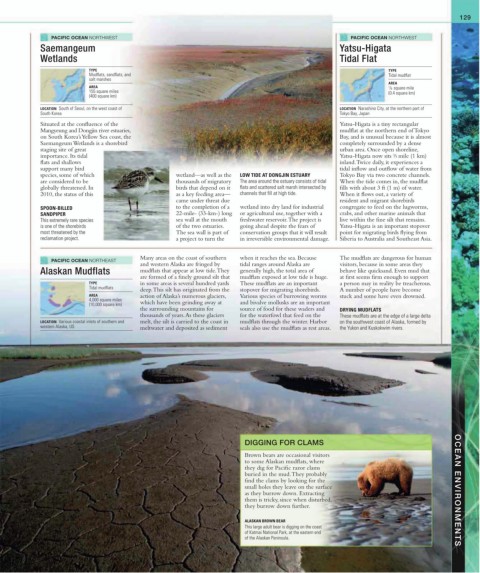
                                                                          DIGGING FOR CLAMS
                                                                          Brown bears are occasional visitors
                                                                          to some Alaskan mudflats, where
                                                                          they dig for Pacific razor clams
                                                                          buried in the mud. They probably
                                                                          find the clams by looking for the
                                                                          small holes they leave on the surface                          OCEAN ENVIRONMENTS
                                                                          as they burrow down. Extracting
                                                                          them is tricky, since when disturbed,
                                                                          they burrow down further.

                                                                          ALASKAN BROWN BEAR
                                                                          This large adult bear is digging on the coast
                                                                          of Katmai National Park, at the eastern end
                                                                          of the Alaskan Peninsula.

