


Page 137 - (DK) Ocean - The Definitive Visual Guide
P. 137
135


                PACIFIC OCEAN WEST         Irrawaddy dolphins are also
                                           occasionally spotted in the region,
             Kinabatangan                  while other spectacular inhabitants
                                           include Borneo’s indigenous proboscis
             Mangroves                     monkey and the saltwater crocodile
                                           (the world’s largest crocodile species),
                           PRINCIPAL SPECIES  Stilt
                           mangrove, long-fruited   which was almost hunted to
                           stilt mangrove, gray   extinction but whose numbers are
                           mangrove, nipa palm   now recovering. Over the past
                           AREA  400 square miles   30 years, there has been extensive
                           (1,000 square km)
                                           clearance of mangroves in the
                                           Kinabatangan delta for purposes of
             LOCATION  Southeast of Sandakan, eastern Sabah,
             Malaysia                      timber and charcoal production. The
                                           mangroves have either been replaced
             Mangrove swamps occupy a coastal   by oil palms or the cleared land has
             region of the Kinabatangan River delta,   been developed for shrimp farming.
             within eastern Sabah in the northern   Inevitably, the wildlife has suffered,
             part of the island of Borneo. The   but the government of Sabah is now
             mangrove swamps in this area form    engaged in a large-scale mangrove
             a complex mosaic with other types of   replanting operation.
             lowland forest (including palm forest)
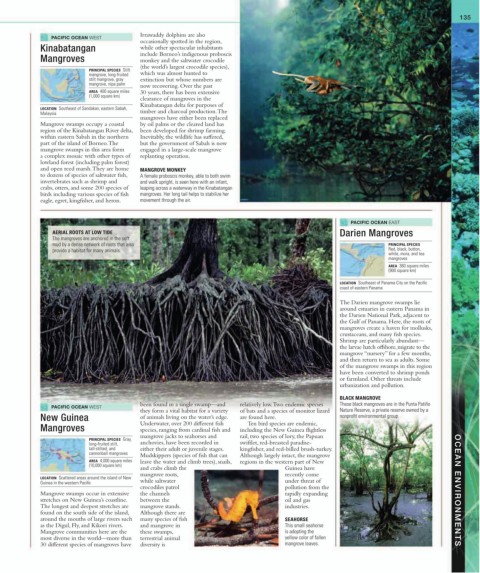
             and open reed marsh. They are home   MANGROVE MONKEY
             to dozens of species of saltwater fish,   A female proboscis monkey, able to both swim
             invertebrates such as shrimp and    and walk upright, is seen here with an infant,
             crabs, otters, and some 200 species of   leaping across a waterway in the Kinabatangan
             birds including various species of fish   mangroves. Her long tail helps to stabilize her
             eagle, egret, kingfisher, and heron.   movement through the air.


                                                                                                         PACIFIC OCEAN EAST
                 AERIAL ROOTS AT LOW TIDE                                                             Darien Mangroves
                 The mangroves are anchored in the soft
                 mud by a dense network of roots that also                                                           PRINCIPAL SPECIES
                 provide a habitat for many animals.                                                                 Red, black, button,
                                                                                                                     white, mora, and tea
                                                                                                                     mangroves
                                                                                                                     AREA  360 square miles
                                                                                                                     (900 square km)
                                                                                                      LOCATION  Southeast of Panama City on the Pacific
                                                                                                      coast of eastern Panama

                                                                                                      The Darien mangrove swamps lie
                                                                                                      around estuaries in eastern Panama in
                                                                                                      the Darien National Park, adjacent to
                                                                                                      the Gulf of Panama. Here, the roots of
                                                                                                      mangroves create a haven for mollusks,
                                                                                                      crustaceans, and many fish species.
                                                                                                      Shrimp are particularly abundant—
                                                                                                      the larvae hatch offshore, migrate to the
                                                                                                      mangrove “nursery” for a few months,
                                                                                                      and then return to sea as adults. Some
                                                                                                      of the mangrove swamps in this region
                                                                                                      have been converted to shrimp ponds
                                                                                                      or farmland. Other threats include
                                                                                                      urbanization and pollution.

                                                                                                      BLACK MANGROVE
                PACIFIC OCEAN WEST         been found in a single swamp—and   relatively low. Two endemic species    These black mangroves are in the Punta Patiño
                                           they form a vital habitat for a variety   of bats and a species of monitor lizard   Nature Reserve, a private reserve owned by a
             New Guinea                    of animals living on the water’s edge.   are found here.   nonprofit environmental group.
                                           Underwater, over 200 different fish   Ten bird species are endemic,
             Mangroves                     species, ranging from cardinal fish and   including the New Guinea flightless
                                           mangrove jacks to seahorses and   rail, two species of lory, the Papuan
                           PRINCIPAL SPECIES  Gray,
                           long-fruited stilt,   anchovies, have been recorded in   swiftlet, red-breasted paradise-
                           tall-stilted, and   either their adult or juvenile stages.   kingfisher, and red-billed brush-turkey.
                           cannonball mangroves   Mudskippers (species of fish that can   Although largely intact, the mangrove
                           AREA  4,000 square miles   leave the water and climb trees), snails,   regions in the western part of New
                           (10,000 square km)
                                           and crabs climb the                        Guinea have
                                           mangrove roots,                            recently come
             LOCATION  Scattered areas around the island of New
             Guinea in the western Pacific  while saltwater                            under threat of
                                           crocodiles patrol                          pollution from the                                 OCEAN ENVIRONMENTS
             Mangrove swamps occur in extensive   the channels                        rapidly expanding
             stretches on New Guinea’s coastline.   between the                       oil and gas
             The longest and deepest stretches are   mangrove stands.                 industries.
             found on the south side of the island,   Although there are
             around the mouths of large rivers such   many species of fish            SEAHORSE
             as the Digul, Fly, and Kikori rivers.   and mangrove in                  This small seahorse
             Mangrove communities here are the   these swamps,                        is adopting the
             most diverse in the world—more than   terrestrial animal                 yellow color of fallen
             30 different species of mangroves have   diversity is                    mangrove leaves.

