


Page 142 - (DK) Ocean - The Definitive Visual Guide
P. 142
140     SHALLOW SEAS


               Continental Shelves                                                                    DISCOVERY
                                                                                                      FIORDS

               CONTINENTAL SHELVES ARE ESSENTIALLY the flooded edges of continents,                   Fiords are deep, sheltered sea
                                                                                                      inlets originally gouged out by
               inundated by sea-level rise after the last ice age. The shelf seabed is now            glaciers and then flooded by the
               approximately 600ft (200m) below the surface, and its width varies, occasionally       sea. They often extend many
                                                                                                      kilometres inland and are made
               extending to hundreds of miles. The shelf seabed and water quality are                 up of deep basins, separated from
               influenced by land processes. Rivers bring fresh water and nutrients, making           the open sea by shallow sills.
                                                                                                        This basin-and-sill structure
               shelf waters very productive ecologically, while river-borne material settles on       has a huge influence on marine
               the seabed as sediment. The continental shelf has a huge diversity of marine life      life. In this sheltered environment,
                                                                                                      still, dark salt water lies beneath
               and habitats, but it is also the area of the sea that suffers most from pollutants.    peaty fresh water. This mimics
                                                                                                      the marine conditions off the
                                                                                                      continental shelf, and animals
                                               Fertile Fringes                                        normally confined to much deeper
                                                                                                      water, such as cold-water corals,
                                               The coastal fringes have the greatest diversity of life in the   inhabit water shallow enough for
                                               oceans. Light penetration is highly variable, from turbid basins   divers to explore.
                                               to clear tropical waters. In many places, enough light reaches the
                                               shallow sea bed for good growth of photosynthetic organisms.
                                               Seaweeds, seagrasses, and phytoplankton thrive here, fed by solar
                                               energy, nutrients from land, and sediments stirred up by winds
                                               and currents. The coastal fringes are much more productive than
                                               the open oceans. Combined with diverse habitats, this results in
                                               complex marine communities, making rich feeding and nursery
                                               grounds for animals from deeper water. In higher latitudes,
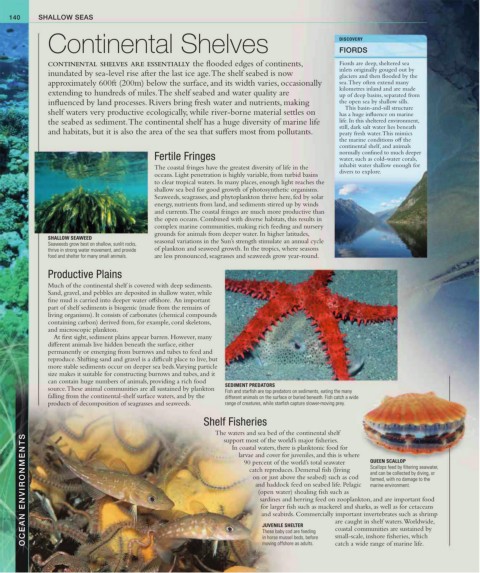
               SHALLOW SEAWEED
               Seaweeds grow best on shallow, sunlit rocks,   seasonal variations in the Sun’s strength stimulate an annual cycle
               thrive in strong water movement, and provide   of plankton and seaweed growth. In the tropics, where seasons
               food and shelter for many small animals.  are less pronounced, seagrasses and seaweeds grow year-round.

               Productive Plains

               Much of the continental shelf is covered with deep sediments.
               Sand, gravel, and pebbles are deposited in shallow water, while
               fine mud is carried into deeper water offshore.  An important
               part of shelf sediments is biogenic (made from the remains of
               living organisms). It consists of carbonates (chemical compounds
               containing carbon) derived from, for example, coral skeletons,
               and microscopic plankton.
                 At first sight, sediment plains appear barren. However, many
               different animals live hidden beneath the surface, either
               permanently or emerging from burrows and tubes to feed and
               reproduce. Shifting sand and gravel is a difficult place to live, but
               more stable sediments occur on deeper sea beds. Varying particle
               size makes it suitable for constructing burrows and tubes, and it
               can contain huge numbers of animals, providing a rich food
                                                                    SEDIMENT PREDATORS
               source. These animal communities are all sustained by plankton
                                                                    Fish and starfish are top predators on sediments, eating the many
               falling from the continental-shelf surface waters, and by the   different animals on the surface or buried beneath. Fish catch a wide
               products of decomposition of seagrasses and seaweeds.  range of creatures, while starfish capture slower-moving prey.

                                                              Shelf Fisheries
                                                                 The waters and sea bed of the continental shelf   QUEEN SCALLOP
        OCEAN ENVIRONMENTS                                                90 percent of the world’s total seawater    Scallops feed by filtering seawater,
                                                                    support most of the world’s major fisheries.
                                                                      In coastal waters, there is planktonic food for
                                                                        larvae and cover for juveniles, and this is where

                                                                           catch reproduces. Demersal fish (living
                                                                                                               and can be collected by diving, or
                                                                            on or just above the seabed) such as cod
                                                                                                               farmed, with no damage to the
                                                                             and haddock feed on seabed life. Pelagic
                                                                                                               marine environment.
                                                                              (open water) shoaling fish such as
                                                                              sardines and herring feed on zooplankton, and are important food
                                                                               for larger fish such as mackerel and sharks, as well as for cetaceans
                                                                               and seabirds. Commercially important invertebrates such as shrimp
                                                                                                     are caught in shelf waters. Worldwide,
                                                                               JUVENILE SHELTER
                                                                                                     coastal communities are sustained by
                                                                               These baby cod are feeding
                                                                                                     small-scale, inshore fisheries, which
                                                                               in horse mussel beds, before
                                                                                                     catch a wide range of marine life.
                                                                               moving offshore as adults.

