


Page 172 - (DK) Ocean - The Definitive Visual Guide
P. 172
170     THE OPEN OCEAN AND OCEAN FLOOR


               Plankton and Nekton                                                              The Twilight Zone

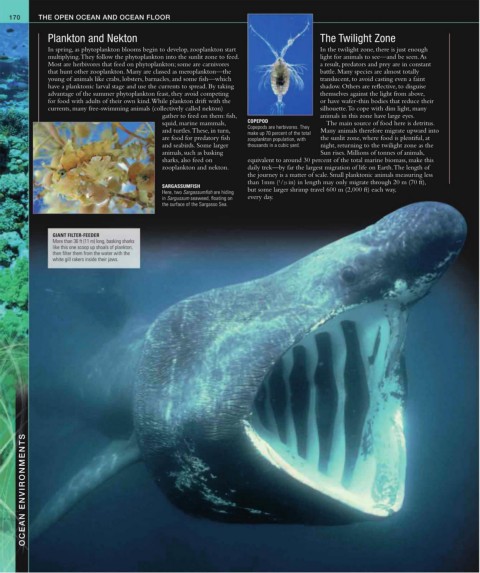
               In spring, as phytoplankton blooms begin to develop, zooplankton start           In the twilight zone, there is just enough
               multiplying. They follow the phytoplankton into the sunlit zone to feed.         light for animals to see—and be seen. As
               Most are herbivores that feed on phytoplankton; some are carnivores              a result, predators and prey are in constant
               that hunt other zooplankton. Many are classed as meroplankton—the                battle. Many species are almost totally
               young of animals like crabs, lobsters, barnacles, and some fish—which            translucent, to avoid casting even a faint
               have a planktonic larval stage and use the currents to spread. By taking         shadow. Others are reflective, to disguise
               advantage of the summer phytoplankton feast, they avoid competing                themselves against the light from above,
               for food with adults of their own kind. While plankton drift with the            or have wafer-thin bodies that reduce their
               currents, many free-swimming animals (collectively called nekton)                silhouette. To cope with dim light, many
                                                 gather to feed on them: fish,                  animals in this zone have large eyes.
                                                 squid, marine mammals,    COPEPOD                The main source of food here is detritus.
                                                                           Copepods are herbivores. They
                                                 and turtles. These, in turn,                   Many animals therefore migrate upward into
                                                                           make up 70 percent of the total
                                                 are food for predatory fish   zooplankton population, with   the sunlit zone, where food is plentiful, at
                                                 and seabirds. Some larger   thousands in a cubic yard.           night, returning to the twilight zone as the
                                                 animals, such as basking                       Sun rises. Millions of tonnes of animals,
                                                 sharks, also feed on      equivalent to around 30 percent of the total marine biomass, make this
                                                 zooplankton and nekton.   daily trek—by far the largest migration of life on Earth. The length of
                                                                           the journey is a matter of scale. Small planktonic animals measuring less
                                                                                    1
                                                                           than 1mm ( /25 in) in length may only migrate through 20 m (70 ft),
                                                 SARGASSUMFISH
                                                 Here, two Sargassumfish are hiding   but some larger shrimp travel 600 m (2,000 ft) each way,
                                                 in Sargussum seaweed, floating on   every day.
                                                 the surface of the Sargasso Sea.


                 GIANT FILTER-FEEDER
                 More than 36 ft (11 m) long, basking sharks
                 like this one scoop up shoals of plankton,
                 then filter them from the water with the
                 white gill rakers inside their jaws.


        OCEAN ENVIRONMENTS

