Page 175 - (DK) Ocean - The Definitive Visual Guide
P. 175
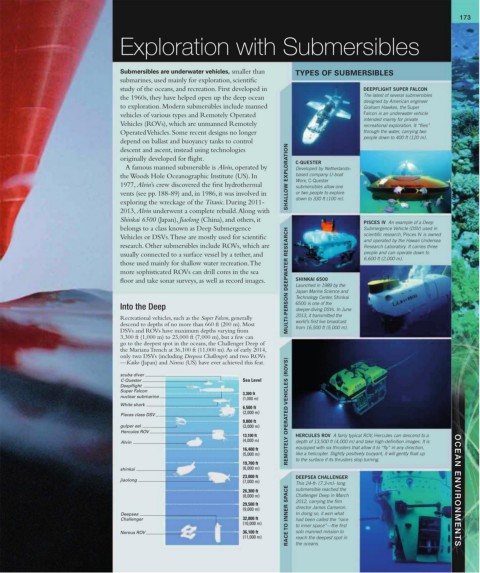
173


                                     Exploration with Submersibles


                                     Submersibles are underwater vehicles, smaller than
                                                                                         TYPES OF SUBMERSIBLES
                                     submarines, used mainly for exploration, scientific
                                     study of the oceans, and recreation. First developed in                 DEEPFLIGHT SUPER FALCON
                                     the 1960s, they have helped open up the deep ocean                      The latest of several submersibles
                                                                                                             designed by American engineer
                                     to exploration. Modern submersibles include manned                      Graham Hawkes, the Super
                                     vehicles of various types and Remotely Operated                         Falcon is an underwater vehicle
                                                                                                             intended mainly for private
                                     Vehicles (ROVs), which are unmanned Remotely                            recreational exploration. It “flies”
                                     Operated Vehicles. Some recent designs no longer                        through the water, carrying two
                                                                                                             people down to 400 ft (120 m).
                                     depend on ballast and buoyancy tanks to control
                                     descent and ascent, instead using technologies
                                     originally developed for flight.                    C-QUESTER
                                        A famous manned submersible is Alvin, operated by   Developed by Netherlands-
                                     the Woods Hole Oceanographic Institute (US). In   SHALLOW EXPLORATION  based company U-boat
                                                                                         Worx, C-Quester
                                     1977, Alvin’s crew discovered the first hydrothermal   submersibles allow one
                                     vents (see pp. 188-89) and, in 1986, it was involved in   or two people to explore
                                     exploring the wreckage of the Titanic. During 2011-  down to 330 ft (100 m).
                                     2013, Alvin underwent a complete rebuild. Along with
                                     Shinkai 6500 (Japan), Jiaolong (China), and others, it
                                                                                                             PISCES IV  An example of a Deep
                                     belongs to a class known as Deep Submergence                            Submergence Vehicle (DSV) used in
                                     Vehicles or DSVs. These are mostly used for scientific                  scientific research, Pisces IV is owned
                                                                                                             and operated by the Hawaii Undersea
                                     research. Other submersibles include ROVs, which are                    Research Laboratory. It carries three
                                     usually connected to a surface vessel by a tether, and                  people and can operate down to
                                                                                                             6,600 ft (2,000 m).
                                     those used mainly for shallow water recreation. The
                                     more sophisticated ROVs can drill cores in the sea
                                     floor and take sonar surveys, as well as record images.  MULTI-PERSON DEEPWATER RESEARCH  SHINKAI 6500
                                                                                         Launched in 1989 by the
                                                                                         Japan Marine Science and
                                                                                         6500 is one of the
                                     Into the Deep                                       Technology Center, Shinkai
                                                                                         deeper-diving DSVs. In June
                                     Recreational vehicles, such as the Super Falcon, generally   2013, it transmitted the
                                                                                         world’s first live broadcast
                                     descend to depths of no more than 660 ft (200 m). Most    from 16,500 ft (5,000 m).
                                     DSVs and ROVs have maximum depths varying from
                                     3,300 ft (1,000 m) to 23,000 ft (7,000 m), but a few can
                                     go to the deepest spot in the oceans, the Challenger Deep of
                                     the Mariana Trench at 36,100 ft (11,000 m). As of early 2014,
                                     only two DSVs (including Deepsea Challenger) and two ROVs
                                     —Kaiko (Japan) and Nereus (US) have ever achieved this feat.

                                     scuba diver
                                     C-Quester                           Sea Level
                                     Deepflight
                                     Super Falcon
                                                                         3,300 ft
                                     nuclear submarine
                                                                         (1,000 m)
                                     White shark
                                                                         6,500 ft
                                                                         (2,000 m)     REMOTELY OPERATED VEHICLES (ROVS)
                                     Pisces class DSV
                                                                         9,800 ft
                                     gulper eel                          (3,000 m)
                                     Hercules ROV
                                                                         13,100 ft       HERCULES ROV  A fairly typical ROV, Hercules can descend to a
                                     Alvin                               (4,000 m)       depth of 13,500 ft (4,000 m) and take high-definition images. It is
                                                                         16,400 ft       equipped with six thrusters that allow it to “fly” in any direction,
                                                                         (5,000 m)       like a helicopter. Slightly positively buoyant, it will gently float up
                                                                         19,700 ft       to the surface if its thrusters stop turning.
                                     shinkai                             (6,000 m)
                                                                         23,000 ft       DEEPSEA CHALLENGER
                                     jiaolong
                                                                         (7,000 m)       This 24-ft- (7.3-m)- long
                                                                         26,300 ft       submersible reached the                         OCEAN ENVIRONMENTS
                                                                         (8,000 m)       Challenger Deep in March
                                                                         29,500 ft       2012, carrying the film
                                                                         (9,000 m)       director James Cameron.
                                     Deepsea                                           RACE TO INNER SPACE  In doing so, it won what
                                     Challenger                          32,800 ft       had been called the “race
                                                                         (10,000 m)      to inner space”—the first
                                     Nereus ROV                          36,100 ft       solo manned mission to
                                                                         (11,000 m)      reach the deepest spot in
                                                                                         the oceans.
   170   171   172   173   174   175   176   177   178   179   180