


Page 176 - (DK) Ocean - The Definitive Visual Guide
P. 176
174     THE OPEN OCEAN AND OCEAN FLOOR


               Seamounts and Guyots


               SEAMOUNTS ARE TOTALLY submerged, undersea                    PEOPLE
               mountains that rise at least 3,300 ft (1,000 m) from         HENRY GUYOT
               the sea floor; smaller ones are called sea knolls. Guyots
               are seamounts that once rose above sea level—as a            Arnold Henry Guyot (1807–1884)
                                                                            was the first professor of geology
               result, they have a flat top caused by erosion. Often        at Princeton University. He set up
               isolated in deep ocean, seamounts and guyots provide         a system of weather observatories
                                                                            that led to the formation of the
               a habitat for marine life adapted to shallower water.        US Weather Bureau. Guyots were
               The obstruction of a seamount forces nutrient-rich,          named in his honor by a later
                                                                            Princeton geology professor,
               deep-sea currents to rise closer to the surface, forming     Harry Hass. Hass discovered guyots
                                                                            using echo-sounding equipment
               eddies above the seamount. These trap nutrients and
                                                                            during World War II.
               support plankton, which in turn attract shoals of fish.


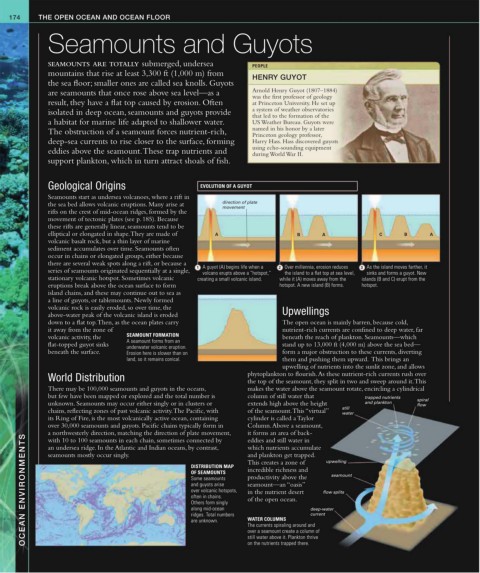
               Geological Origins                            EVOLUTION OF A GUYOT
               Seamounts start as undersea volcanoes, where a rift in
               the sea bed allows volcanic eruptions. Many arise at   direction of plate
                                                                   movement
               rifts on the crest of mid-ocean ridges, formed by the
               movement of tectonic plates (see p. 185). Because
               these rifts are generally linear, seamounts tend to be
               elliptical or elongated in shape. They are made of    A                    B       A                C      B       A
               volcanic basalt rock, but a thin layer of marine
               sediment accumulates over time. Seamounts often
               occur in chains or elongated groups, either because
               there are several weak spots along a rift, or because a
                                                           1  A guyot (A) begins life when a   2  Over millennia, erosion reduces   3  As the island moves farther, it
               series of seamounts originated sequentially at a single,   volcano erupts above a “hotspot,”   the island to a flat top at sea level,   sinks and forms a guyot. New
               stationary volcanic hotspot. Sometimes volcanic   creating a small volcanic island.    while it (A) moves away from the   islands (B and C) erupt from the
               eruptions break above the ocean surface to form                      hotspot. A new island (B) forms.   hotspot.
               island chains, and these may continue out to sea as
               a line of guyots, or tablemounts. Newly formed
               volcanic rock is easily eroded, so over time, the                     Upwellings
               above-water peak of the volcanic island is eroded
               down to a flat top. Then, as the ocean plates carry                   The open ocean is mainly barren, because cold,
               it away from the zone of                                              nutrient-rich currents are confined to deep water, far
               volcanic activity, the   SEAMOUNT FORMATION                           beneath the reach of plankton. Seamounts—which
                                       A seamount forms from an
               flat-topped guyot sinks                                               stand up to 13,000 ft (4,000 m) above the sea bed—
                                       underwater volcanic eruption.
               beneath the surface.    Erosion here is slower than on                form a major obstruction to these currents, diverting
                                       land, so it remains conical.                  them and pushing them upward.  This brings an
                                                                                     upwelling of nutrients into the sunlit zone, and allows
               World Distribution                                          phytoplankton to flourish. As these nutrient-rich currents rush over
                                                                           the top of the seamount, they split in two and sweep around it. This
               There may be 100,000 seamounts and guyots in the oceans,    makes the water above the seamount rotate, encircling a cylindrical
               but few have been mapped or explored and the total number is    column of still water that     trapped nutrients    spiral
               unknown. Seamounts may occur either singly or in clusters or    extends high above the height   and plankton  flow
                                                                                                       still
               chains, reflecting zones of past volcanic activity. The Pacific, with    of the seamount. This “virtual”
                                                                                                       water
               its Ring of Fire, is the most volcanically active ocean, containing    cylinder is called a Taylor
               over 30,000 seamounts and guyots. Pacific chains typically form in   Column. Above a seamount,
               a northwesterly direction, matching the direction of plate movement,   it forms an area of back-  upwelling
        OCEAN ENVIRONMENTS                                DISTRIBUTION MAP  This creates a zone of   deep-water
                                                                           eddies and still water in
               with 10 to 100 seamounts in each chain, sometimes connected by
                                                                           which nutrients accumulate
               an undersea ridge. In the Atlantic and Indian oceans, by contrast,
               seamounts mostly occur singly.
                                                                           and plankton get trapped.
                                                                           incredible richness and
                                                          OF SEAMOUNTS
                                                                                                    seamount
                                                                           productivity above the
                                                          Some seamounts
                                                                           seamount—an “oasis”
                                                          and guyots arise
                                                          over volcanic hotspots,
                                                                           in the nutrient desert
                                                                                                 flow splits
                                                          often in chains.
                                                                           of the open ocean.
                                                          Others form singly
                                                          along mid-ocean
                                                                                             current
                                                          ridges. Total numbers
                                                                           WATER COLUMNS
                                                          are unknown.
                                                                           The currents spiraling around and
                                                                           over a seamount create a column of
                                                                           still water above it. Plankton thrive
                                                                           on the nutrients trapped there.

