


Page 202 - (DK) Ocean - The Definitive Visual Guide
P. 202
200     POLAR OCEANS


               Polar Ocean Circulation


               THE ARCTIC AND SOUTHERN OCEANS each have their own unique patterns
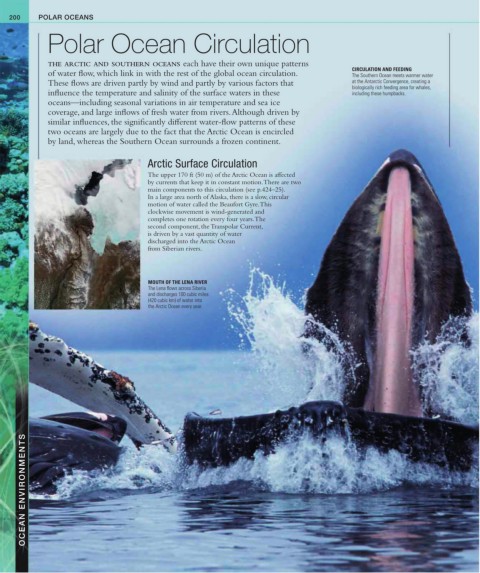
                                                                                                          CIRCULATION AND FEEDING
               of water flow, which link in with the rest of the global ocean circulation.                The Southern Ocean meets warmer water
               These flows are driven partly by wind and partly by various factors that                   at the Antarctic Convergence, creating a
                                                                                                          biologically rich feeding area for whales,
               influence the temperature and salinity of the surface waters in these                      including these humpbacks.
               oceans—including seasonal variations in air temperature and sea ice
               coverage, and large inflows of fresh water from rivers. Although driven by
               similar influences, the significantly different water-flow patterns of these
               two oceans are largely due to the fact that the Arctic Ocean is encircled
               by land, whereas the Southern Ocean surrounds a frozen continent.


                                             Arctic Surface Circulation
                                             The upper 170 ft (50 m) of the Arctic Ocean is affected
                                             by currents that keep it in constant motion. There are two
                                             main components to this circulation (see p.424–25).
                                             In a large area north of Alaska, there is a slow, circular
                                             motion of water called the Beaufort Gyre. This
                                             clockwise movement is wind-generated and
                                             completes one rotation every four years. The
                                             second component, the Transpolar Current,
                                             is driven by a vast quantity of water
                                             discharged into the Arctic Ocean
                                             from Siberian rivers.


                                             MOUTH OF THE LENA RIVER
                                             The Lena flows across Siberia
                                             and discharges 100 cubic miles
                                             (420 cubic km) of water into
                                             the Arctic Ocean every year.


        OCEAN ENVIRONMENTS

