


Page 199 - (DK) Ocean - The Definitive Visual Guide
P. 199
197


                                     The Titanic Disaster


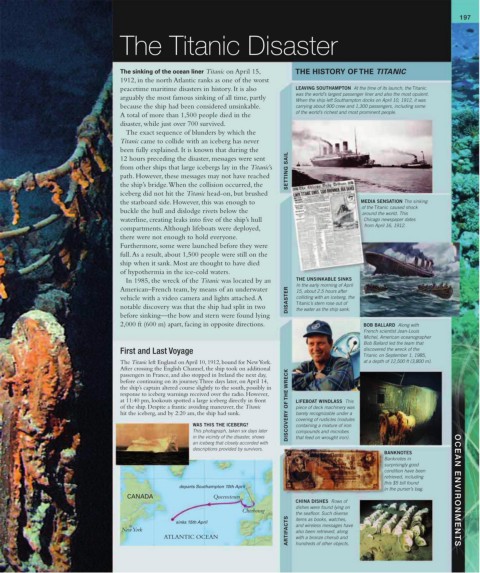
                                     The sinking of the ocean liner Titanic on April 15,   THE HISTORY OF THE TITANIC
                                     1912, in the north Atlantic ranks as one of the worst
                                     peacetime maritime disasters in history. It is also   LEAVING SOUTHAMPTON  At the time of its launch, the Titanic
                                                                                         was the world’s largest passenger liner and also the most opulent.
                                     arguably the most famous sinking of all time, partly
                                                                                         When the ship left Southampton docks on April 10, 1912, it was
                                     because the ship had been considered unsinkable.    carrying about 900 crew and 1,300 passengers, including some
                                                                                         of the world’s richest and most prominent people.
                                     A total of more than 1,500 people died in the
                                     disaster, while just over 700 survived.
                                      The exact sequence of blunders by which the
                                     Titanic came to collide with an iceberg has never
                                     been fully explained. It is known that during the
                                     12 hours preceding the disaster, messages were sent
                                     from other ships that large icebergs lay in the Titanic’s   SETTING SAIL
                                     path. However, these messages may not have reached
                                     the ship’s bridge. When the collision occurred, the
                                     iceberg did not hit the Titanic head-on, but brushed
                                     the starboard side. However, this was enough to                        MEDIA SENSATION The sinking
                                                                                                             of the Titanic caused shock
                                     buckle the hull and dislodge rivets below the
                                                                                                             around the world. This
                                     waterline, creating leaks into five of the ship’s hull                  Chicago newspaper dates
                                                                                                             from April 16, 1912.
                                     compartments. Although lifeboats were deployed,
                                     there were not enough to hold everyone.
                                     Furthermore, some were launched before they were
                                     full. As a result, about 1,500 people were still on the
                                     ship when it sank. Most are thought to have died
                                     of hypothermia in the ice-cold waters.
                                      In 1985, the wreck of the Titanic was located by an   THE UNSINKABLE SINKS
                                                                                         In the early morning of April
                                     American–French team, by means of an underwater     15, about 2.5 hours after
                                     vehicle with a video camera and lights attached. A   DISASTER  colliding with an iceberg, the
                                     notable discovery was that the ship had split in two   Titanic’s stern rose out of
                                                                                         the water as the ship sank.
                                     before sinking—the bow and stern were found lying
                                     2,000 ft (600 m) apart, facing in opposite directions.                  BOB BALLARD  Along with
                                                                                                             French scientist Jean-Louis
                                                                                                             Michel, American oceanographer
                                                                                                             Bob Ballard led the team that
                                     First and Last Voyage                                                   discovered the wreck of the
                                                                                                             Titanic on September 1, 1985,
                                     The Titanic left England on April 10, 1912, bound for New York.         at a depth of 12,500 ft (3,800 m).
                                     After crossing the English Channel, the ship took on additional
                                     passengers in France, and also stopped in Ireland the next day,
                                     before continuing on its journey. Three days later, on April 14,
                                     the ship’s captain altered course slightly to the south, possibly in
                                     response to iceberg warnings received over the radio. However,
                                     at 11:40 pm, lookouts spotted a large iceberg directly in front   LIFEBOAT WINDLASS  This
                                     of the ship. Despite a frantic avoiding maneuver, the Titanic    DISCOVERY OF THE WRECK  piece of deck machinery was
                                     hit the iceberg, and by 2:20 am, the ship had sunk.  barely recognizable under a

                                                          WAS THIS THE ICEBERG?          covering of rusticles (nodules
                                                                                         containing a mixture of iron
                                                          This photograph, taken six days later    compounds and microbes
                                                          in the vicinity of the disaster, shows    that feed on wrought iron).
                                                          an iceberg that closely accorded with
                                                          descriptions provided by survivors.
                                                                                                                   BANKNOTES
                                                                                                                   Banknotes in
                                                                                                                   surprisingly good
                                                                                                                   condition have been
                                                                                                                   retrieved, including
                                                                                                                   this $5 bill found
                                                      departs Southampton 10th April
                                                                                                                   in the purser’s bag.  OCEAN ENVIRONMENTS
                                       CANADA                   Queenstown
                                                                                         CHINA DISHES  Rows of
                                                                                         dishes were found lying on
                                                                         Cherbourg
                                                                                         the seafloor. Such diverse
                                                                                       ARTIFACTS  also been retrieved, along
                                                     sinks 15th April                    items as books, watches,
                                                                                         and wireless messages have
                                     New York
                                                  ATLANTIC OCEAN                         with a bronze cherub and
                                                                                         hundreds of other objects.

