


Page 200 - (DK) Ocean - The Definitive Visual Guide
P. 200
198     POLAR OCEANS


               Sea Ice                                                        TESTING THE ICE


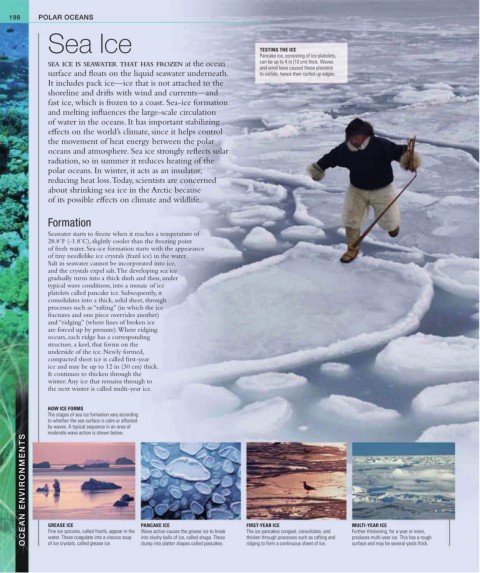
                                                                              Pancake ice, consisting of ice platelets,
               SEA ICE IS SEAWATER THAT HAS FROZEN at the ocean               can be up to 4 in (10 cm) thick. Waves
                                                                              and wind have caused these platelets
               surface and floats on the liquid seawater underneath.          to collide, hence their curled-up edges.
               It includes pack ice—ice that is not attached to the
               shoreline and drifts with wind and currents—and
               fast ice, which is frozen to a coast. Sea-ice formation
               and melting influences the large-scale circulation
               of water in the oceans. It has important stabilizing
               effects on the world’s climate, since it helps control
               the movement of heat energy between the polar
               oceans and atmosphere. Sea ice strongly reflects solar
               radiation, so in summer it reduces heating of the
               polar oceans. In winter, it acts as an insulator,
               reducing heat loss. Today, scientists are concerned
               about shrinking sea ice in the Arctic because
               of its possible effects on climate and wildlife.


               Formation
               Seawater starts to freeze when it reaches a temperature of
               28.8˚F (-1.8˚C), slightly cooler than the freezing point
               of fresh water. Sea-ice formation starts with the appearance
               of tiny needlelike ice crystals (frazil ice) in the water.
               Salt in seawater cannot be incorporated into ice,
               and the crystals expel salt. The developing sea ice
               gradually turns into a thick slush and then, under
               typical wave conditions, into a mosaic of ice
               platelets called pancake ice. Subsequently, it
               consolidates into a thick, solid sheet, through
               processes such as “rafting” (in which the ice
               fractures and one piece overrides another)
               and “ridging” (where lines of broken ice
               are forced up by pressure). Where ridging
               occurs, each ridge has a corresponding
               structure, a keel, that forms on the
               underside of the ice. Newly formed,
               compacted sheet ice is called first-year
               ice and may be up to 12 in (30 cm) thick.
               It continues to thicken through the
               winter. Any ice that remains through to
               the next winter is called multi-year ice.


               HOW ICE FORMS
               The stages of sea ice formation vary according
               to whether the sea surface is calm or affected
               by waves. A typical sequence in an area of
               moderate wave action is shown below.
        OCEAN ENVIRONMENTS  GREASE ICE     PANCAKE ICE                    FIRST-YEAR ICE                  MULTI-YEAR ICE


                                                                          The ice pancakes congeal, consolidate, and
                                                                                                          Further thickening, for a year or more,
               Fine ice spicules, called frazils, appear in the  Wave action causes the grease ice to break
               water. These coagulate into a viscous soup
                                                                          thicken through processes such as rafting and
                                                                                                          produces multi-year ice. This has a rough
                                           into slushy balls of ice, called shuga. These
               of ice crystals, called grease ice.
                                                                                                          surface and may be several yards thick.
                                           clump into platter shapes called pancakes.
                                                                          ridging to form a continuous sheet of ice.

