


Page 201 - (DK) Ocean - The Definitive Visual Guide
P. 201
SEA ICE 199
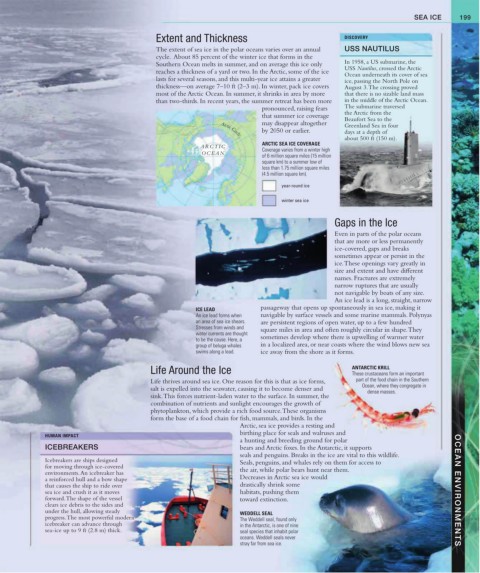
Extent and Thickness DISCOVERY
The extent of sea ice in the polar oceans varies over an annual USS NAUTILUS
cycle. About 85 percent of the winter ice that forms in the
Southern Ocean melts in summer, and on average this ice only In 1958, a US submarine, the
reaches a thickness of a yard or two. In the Arctic, some of the ice USS Nautilus, crossed the Arctic
Ocean underneath its cover of sea
lasts for several seasons, and this multi-year ice attains a greater ice, passing the North Pole on
thickness—on average 7–10 ft (2–3 m). In winter, pack ice covers August 3. The crossing proved
most of the Arctic Ocean. In summer, it shrinks in area by more that there is no sizable land mass
than two-thirds. In recent years, the summer retreat has been more in the middle of the Arctic Ocean.
pronounced, raising fears The submarine traversed
that summer ice coverage the Arctic from the
Beaufort Sea to the
may disappear altogether Greenland Sea in four
by 2050 or earlier. days at a depth of
Arctic Circle
about 500 ft (150 m).
ARCTIC SEA ICE COVERAGE
ARCTIC
Coverage varies from a winter high
OCEAN
of 6 million square miles (15 million
square km) to a summer low of
less than 1.75 million square miles
(4.5 million square km).
year-round ice
winter sea ice
Gaps in the Ice
Even in parts of the polar oceans
that are more or less permanently
ice-covered, gaps and breaks
sometimes appear or persist in the
ice. These openings vary greatly in
size and extent and have different
names. Fractures are extremely
narrow ruptures that are usually
not navigable by boats of any size.
An ice lead is a long, straight, narrow
passageway that opens up spontaneously in sea ice, making it
ICE LEAD
An ice lead forms when navigable by surface vessels and some marine mammals. Polynyas
an area of sea ice shears. are persistent regions of open water, up to a few hundred
Stresses from winds and square miles in area and often roughly circular in shape. They
water currents are thought
to be the cause. Here, a sometimes develop where there is upwelling of warmer water
group of beluga whales in a localized area, or near coasts where the wind blows new sea
swims along a lead. ice away from the shore as it forms.
Life Around the Ice ANTARCTIC KRILL
These crustaceans form an important
Life thrives around sea ice. One reason for this is that as ice forms, part of the food chain in the Southern
salt is expelled into the seawater, causing it to become denser and Ocean, where they congregate in
dense masses.
sink. This forces nutrient-laden water to the surface. In summer, the
combination of nutrients and sunlight encourages the growth of
phytoplankton, which provide a rich food source. These organisms
form the base of a food chain for fish, mammals, and birds. In the
Arctic, sea ice provides a resting and
birthing place for seals and walruses and
HUMAN IMPACT
a hunting and breeding ground for polar
ICEBREAKERS bears and Arctic foxes. In the Antarctic, it supports
seals and penguins. Breaks in the ice are vital to this wildlife.
Icebreakers are ships designed Seals, penguins, and whales rely on them for access to
for moving through ice-covered
environments. An icebreaker has the air, while polar bears hunt near them.
a reinforced hull and a bow shape Decreases in Arctic sea ice would
that causes the ship to ride over drastically shrink some
sea ice and crush it as it moves habitats, pushing them OCEAN ENVIRONMENTS
forward. The shape of the vessel toward extinction.
clears ice debris to the sides and
under the hull, allowing steady
WEDDELL SEAL
progress. The most powerful modern The Weddell seal, found only
icebreaker can advance through in the Antarctic, is one of nine
sea-ice up to 9 ft (2.8 m) thick. seal species that inhabit polar
oceans. Weddell seals never
stray far from sea ice.

