


Page 218 - (DK) Ocean - The Definitive Visual Guide
P. 218
216     INTRODUCTION TO OCEAN LIFE


               Bottom-living


               ANIMALS LIVING ON THE OCEAN FLOOR or within its sand
               and mud, either moving over it or firmly attached, are called
               benthic animals. On land, plants provide a structural habitat
               within which animals live. In the ocean, this is rarely the case,
               except in shallow, sunlit areas dominated by kelp, seaweeds,
               or seagrasses. Instead, wherever areas of hard sea bed provide
               a stable foundation, a growth of benthic animals develops,
               fixed to the sea bed and often resembling plants. A sea bed
               of shifting sediments is no place for fixed animals.
               Here, a community of burrowers develops instead.
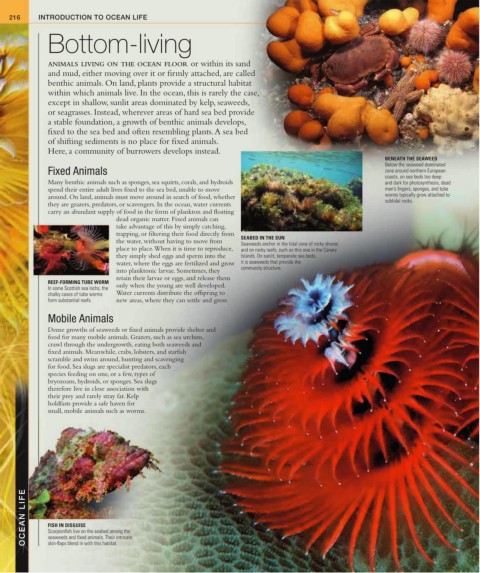
                                                                                                                    BENEATH THE SEAWEED
                                                                                                                    Below the seaweed-dominated
               Fixed Animals                                                                                        zone around northern European
                                                                                                                    coasts, on sea beds too deep
               Many benthic animals such as sponges, sea squirts, corals, and hydroids                              and dark for photosynthesis, dead
               spend their entire adult lives fixed to the sea bed, unable to move                                  man’s fingers, sponges, and tube
               around. On land, animals must move around in search of food, whether                                 worms typically grow attached to
                                                                                                                    subtidal rocks.
               they are grazers, predators, or scavengers. In the ocean, water currents
               carry an abundant supply of food in the form of plankton and floating
                                    dead organic matter. Fixed animals can
                                    take advantage of this by simply catching,
                                    trapping, or filtering their food directly from
                                                                         SEABED IN THE SUN
                                    the water, without having to move from
                                                                         Seaweeds anchor in the tidal zone of rocky shores
                                    place to place. When it is time to reproduce,   and on rocky reefs, such as this one in the Canary
                                    they simply shed eggs and sperm into the   Islands. On sunlit, temperate sea beds,
                                    water, where the eggs are fertilized and grow   it is seaweeds that provide the
                                                                         community structure.
                                    into planktonic larvae. Sometimes, they
                                    retain their larvae or eggs, and release them
               REEF-FORMING TUBE WORM
               In some Scottish sea lochs, the   only when the young are well developed.
               chalky cases of tube worms   Water currents distribute the offspring to
               form substantial reefs.  new areas, where they can settle and grow.
               Mobile Animals

               Dense growths of seaweeds or fixed animals provide shelter and
               food for many mobile animals. Grazers, such as sea urchins,
               crawl through the undergrowth, eating both seaweeds and
               fixed animals. Meanwhile, crabs, lobsters, and starfish
               scramble and swim around, hunting and scavenging
               for food. Sea slugs are specialist predators, each
               species feeding on one, or a few, types of
               bryozoans, hydroids, or sponges. Sea slugs
               therefore live in close association with
               their prey and rarely stray far. Kelp
               holdfasts provide a safe haven for
               small, mobile animals such as worms.


        OCEAN LIFE  FISH IN DISGUISE


               Scorpionfish live on the seabed among the
               seaweeds and fixed animals. Their intricate
               skin-flaps blend in with this habitat.

