


Page 216 - (DK) Ocean - The Definitive Visual Guide
P. 216
214     INTRODUCTION TO OCEAN LIFE


               Swimming and Drifting


               MOST OF THE OCEAN’S LIVING SPACE IS NOT ON THE SEABED but in the water
               column and out in the open ocean—areas known as the pelagic zone. Salt water
               provides support, as well as the nutrients that allow many plants and animals to live
               in the water column without ever going near the seabed. Some animals live at the
               interface between ocean and air, or alternate between both environments, because
               it is more energy-efficient. The water surface, water column, and seabed are all
               interconnected, and many animals move between these habitats.


               Plankton
               The sunlit, surface layers of the ocean are home to many tiny plants and
               animals (plankton) that drift with the water currents. Phytoplankton
               consist of bacteria or plantlike chromists (see p.234) that can
               photosynthesize and make their own food. Along with fixed seaweeds
                               and seagrasses, phytoplankton form the basis of
                               ocean food webs. Zooplankton consists of animals,
                               most of which are very small and feed on the
                               phytoplankton. However, jellyfish can grow to a huge
                               size. Many deep-sea forms have strange shapes and
                               soft bodies that are very delicate. Some zooplankton,
                               such as arrow worms, comb jellies, and copepods,
                               live permanently in the plankton, hunting and
                               grazing (holoplankton), while others are simply the
                               larval and dispersal stages of animals, including crabs,
                               worms, and cnidarians (meroplankton) that will
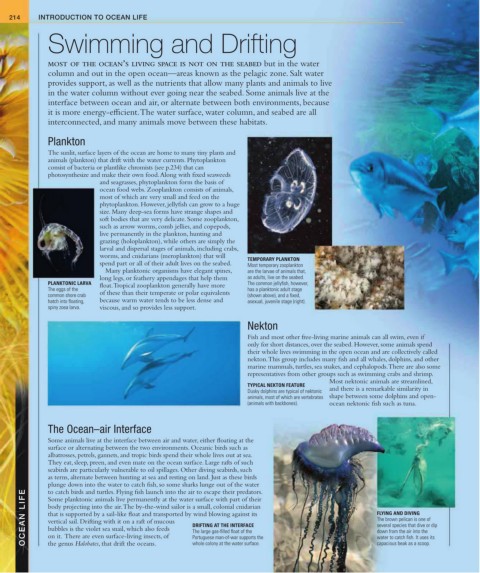
                                                                           TEMPORARY PLANKTON
                               spend part or all of their adult lives on the seabed.  Most temporary zooplankton
                                Many planktonic organisms have elegant spines,   are the larvae of animals that,
                               long legs, or feathery appendages that help them   as adults, live on the seabed.
               PLANKTONIC LARVA  float. Tropical zooplankton generally have more    The common jellyfish, however,
               The eggs of the                                             has a planktonic adult stage
               common shore crab   of these than their temperate or polar equivalents   (shown above), and a fixed,
               hatch into floating,   because warm water tends to be less dense and   asexual, juvenile stage (right).
               spiny zoea larva.  viscous, and so provides less support.

                                                                           Nekton
                                                                           Fish and most other free-living marine animals can all swim, even if
                                                                           only for short distances, over the seabed. However, some animals spend
                                                                           their whole lives swimming in the open ocean and are collectively called
                                                                           nekton. This group includes many fish and all whales, dolphins, and other
                                                                           marine mammals, turtles, sea snakes, and cephalopods. There are also some
                                                                           representatives from other groups such as swimming crabs and shrimp.
                                                                                                   Most nektonic animals are streamlined,
                                                                           TYPICAL NEKTON FEATURE
                                                                           Dusky dolphins are typical of nektonic   and there is a remarkable similarity in
                                                                           animals, most of which are vertebrates   shape between some dolphins and open-
                                                                           (animals with backbones).  ocean nektonic fish such as tuna.


               The Ocean–air Interface

               Some animals live at the interface between air and water, either floating at the
               surface or alternating between the two environments. Oceanic birds such as
               albatrosses, petrels, gannets, and tropic birds spend their whole lives out at sea.
               They eat, sleep, preen, and even mate on the ocean surface. Large rafts of such
               seabirds are particularly vulnerable to oil spillages. Other diving seabirds, such
               as terns, alternate between hunting at sea and resting on land. Just as these birds
               plunge down into the water to catch fish, so some sharks lunge out of the water
               to catch birds and turtles. Flying fish launch into the air to escape their predators.
        OCEAN LIFE  body projecting into the air. The by-the-wind sailor is a small, colonial cnidarian          FLYING AND DIVING
               Some planktonic animals live permanently at the water surface with part of their
               that is supported by a sail-like float and transported by wind blowing against its
                                                                                                                 The brown pelican is one of
               vertical sail. Drifting with it on a raft of mucous
                                                                                                                 several species that dive or dip
                                                          DRIFTING AT THE INTERFACE
               bubbles is the violet sea snail, which also feeds
                                                                                                                 down from the air into the
                                                          The large gas-filled float of the
               on it.  There are even surface-living insects, of
                                                          Portuguese man-of-war supports the
                                                                                                                 water to catch fish. It uses its
               the genus Halobates, that drift the oceans.
                                                                                                                 capacious beak as a scoop.
                                                          whole colony at the water surface.

