


Page 231 - (DK) Ocean - The Definitive Visual Guide
P. 231
229


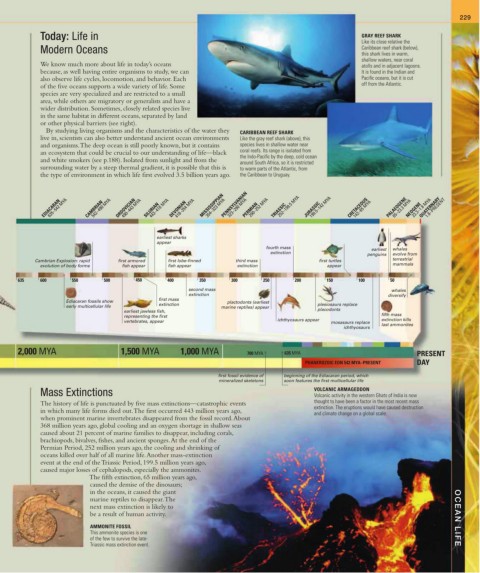
             Today: Life in                                                                                  GRAY REEF SHARK
                                                                                                             Like its close relative the
             Modern Oceans                                                                                   Caribbean reef shark (below),
                                                                                                             this shark lives in warm,
                                                                                                             shallow waters, near coral
             We know much more about life in today’s oceans                                                  atolls and in adjacent lagoons.
             because, as well having entire organisms to study, we can                                       It is found in the Indian and
             also observe life cycles, locomotion, and behavior. Each                                        Pacific oceans, but it is cut
             of the five oceans supports a wide variety of life. Some                                        off from the Atlantic.
             species are very specialized and are restricted to a small
             area, while others are migratory or generalists and have a
             wider distribution. Sometimes, closely related species live
             in the same habitat in different oceans, separated by land
             or other physical barriers (see right).
               By studying living organisms and the characteristics of the water they   CARIBBEAN REEF SHARK
             live in, scientists can also better understand ancient ocean environments   Like the gray reef shark (above), this
             and organisms. The deep ocean is still poorly known, but it contains    species lives in shallow water near
             an ecosystem that could be crucial to our understanding of life—black   coral reefs. Its range is isolated from
                                                                        the Indo-Pacific by the deep, cold ocean
             and white smokers (see p.188). Isolated from sunlight and from the
                                                                        around South Africa, so it is restricted
             surrounding water by a steep thermal gradient, it is possible that this is   to warm parts of the Atlantic, from
             the type of environment in which life first evolved 3.5 billion years ago.  the Caribbean to Uruguay.

                                                                                    252–199.5 MYA
                                                                                              199.5–142 MYA
                                                                                                                            23.3–1.8 MYA
                                                                                                                                1.8–PRESENT
                635–542 MYA
                                                               354–323 MYA
                                                                     323–290 MYA
                             542–490 MYA
                                                                            290–252 MYA
                                              443–418 MYA
                                                      418–354 MYA
                                      490–443 MYA
              EDIACARAN    CAMBRIAN  ORDOVICIAN  SILURIAN  DEVONIAN  MISSISSIPPIAN PENNSYLVANIAN PERMIAN  TRIASSIC  JURASSIC  CRETACEOUS  PALAEOGENE  NEOGENE QUATERNARY
                                                                                                                      65–23.3 MYA
                                                                                                           142–65 MYA
                                                earliest sharks
                                                appear
                                                                                fourth mass                     earliest   whales
                                                                                 extinction
                                                                                                              penguins  evolve from
                                                                                                                      terrestrial
           Cambrian Explosion: rapid   first armored   first lobe-finned   third mass              first turtles
             evolution of body forms  fish appear   fish appear           extinction                appear              mammals
      635    600      550       500      450       400      350       300      250       200      150       100      50
                                                         second mass                                                  whales
                                                         extinction                                                  diversify
                                                first mass
                     Ediacaran fossils show                          plactodonts (earliest
                     early multicellular life   extinction         marine reptiles) appear      plesiosaurs replace
                                      earliest jawless fish,                                     placodonts
                                      representing the first                                                        fifth mass
                                      vertebrates, appear                           ichthyosaurs appear  mosasaurs replace   extinction kills
                                                                                                       ichthyosaurs  last ammonites
      2,000 MYA                      1,500 MYA         1,000 MYA           700 MYA    635 MYA                                PRESENT
                                                                                            PHANEROZOIC EON 542 MYA–PRESENT  DAY
                                                                  first fossil evidence of   beginning of the Ediacaran period, which
                                                                  mineralized skeletons  soon features the first multicellular life
             Mass Extinctions                                                                  VOLCANIC ARMAGEDDON
                                                                                               Volcanic activity in the western Ghats of India is now
             The history of life is punctuated by five mass extinctions—catastrophic events    thought to have been a factor in the most recent mass
                                                                                               extinction. The eruptions would have caused destruction
             in which many life forms died out. The first occurred 443 million years ago,
                                                                                               and climate change on a global scale.
             when prominent marine invertebrates disappeared from the fossil record. About
             368 million years ago, global cooling and an oxygen shortage in shallow seas
             caused about 21 percent of marine families to disappear, including corals,
             brachiopods, bivalves, fishes, and ancient sponges. At the end of the
             Permian Period, 252 million years ago, the cooling and shrinking of
             oceans killed over half of all marine life. Another mass-extinction
             event at the end of the Triassic Period, 199.5 million years ago,
             caused major losses of cephalopods, especially the ammonites.
                            The fifth extinction, 65 million years ago,
                            caused the demise of the dinosaurs;
                            in the oceans, it caused the giant
                            marine reptiles to disappear. The
                            next mass extinction is likely to
                            be a result of human activity.                                                                               OCEAN LIFE

                            AMMONITE FOSSIL
                            This ammonite species is one
                            of the few to survive the late-
                            Triassic mass extinction event.

