


Page 244 - (DK) Ocean - The Definitive Visual Guide
P. 244
242     PLANT LIFE


               Plant Life                                                                  HUMAN IMPACT
                                                                                           BEACH PLANTS

                                       PLANTS FORM A GREAT kingdom of life-forms,          Beach plants grow in places used
                   DOMAIN Eucarya                                                          by humans for recreation. We can
                                       all of which use the pigment chlorophyll to         coexist, especially when people
                  KINGDOM Plantae
                                       fix carbon dioxide from the atmosphere into         use paths in coastal dune areas. In
                   SPECIES 315,000                                                         fact, paths maintain low-growing
                                       organic molecules, using energy from sunlight.      plants, such as mosses, which
               Most organisms in the plant kingdom are “higher” plants, which              might otherwise become
                                                                                           overgrown. However, fragile dunes
               evolved on land and remain land-based. Of these, several unrelated          are damaged by erosion, and plants
               families of flowering plants (see p.250) have since returned to the sea     that grow only in a limited strip
                                                                                           of coastal habitat are highly
               or taken up residence on the coast. The plant kingdom, as defined in        vulnerable to human development.
               this book, also encompasses more primitive organisms that first             SAND CROCUS
                                                                                           The sand crocus of the Canary Islands grows
               evolved in water—the microscopic green algae (microalgae) and               only in a few coastal locations on Lanzarote
               the green and red seaweeds (macroalgae). Brown seaweeds appear              and Fuerteventura. It is protected, but
                                                                                           threatened by tourism development.
               very similar but may not be closely related to true plants and are
               classified in this book in the phylum Chromista (see p.236).

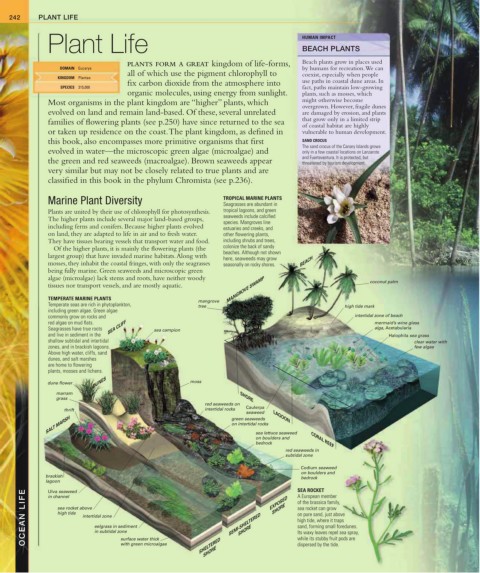
               Marine Plant Diversity                              TROPICAL MARINE PLANTS
                                                                   Seagrasses are abundant in
               Plants are united by their use of chlorophyll for photosynthesis.   tropical lagoons, and green
                                                                   seaweeds include calcified
               The higher plants include several major land-based groups,
                                                                   species. Mangroves line
               including ferns and conifers. Because higher plants evolved    estuaries and creeks, and
               on land, they are adapted to life in air and to fresh water.    other flowering plants,
               They have tissues bearing vessels that transport water and food.   including shrubs and trees,
                 Of the higher plants, it is mainly the flowering plants (the   colonize the back of sandy
                                                                   beaches. Although not shown
               largest group) that have invaded marine habitats. Along with
                                                                   here, seaweeds may grow
               mosses, they inhabit the coastal fringes, with only the seagrasses   seasonally on rocky shores.   BEACH
               being fully marine. Green seaweeds and microscopic green
               algae (microalgae) lack stems and roots, have neither woody                                     coconut palm
               tissues nor transport vessels, and are mostly aquatic.  MANGROVE SWAMP
               TEMPERATE MARINE PLANTS                      mangrove
               Temperate seas are rich in phytoplankton,    tree                                        high tide mark
               including green algae. Green algae
               commonly grow on rocks and                                                                  intertidal zone of beach
               red algae on mud flats.                                                                            mermaid’s wine glass
               Seagrasses have true roots    SEA CLIFF  sea campion                                              alga, Acetabularia
               and live in sediment in the                                                                           Halophila sea grass
               shallow subtidal and intertidal                                                                              clear water with
               zones, and in brackish lagoons.                                                                              few algae
               Above high water, cliffs, sand
               dunes, and salt marshes
               are home to flowering
               plants, mosses and lichens.
                             DUNES
               dune flower                                 moss
                  marram
                  grass                                                  SHORE
                                                              red seaweeds on
                    thrift                                    intertidal rocks  Caulerpa
                                                                          seaweed
                                                                      green seaweeds   LAGOON
               SALT MARSH                                             on intertidal rocks
                                                                             sea lettuce seaweed
                                                                             on boulders and
                                                                             bedrock          CORAL REEF
                                                                                      red seaweeds in
                                                                                      subtidal zone
                                                                                           Codium seaweed
                                                                                           on boulders and
              brackish                                                                     bedrock
              lagoon                                                                      SEA ROCKET
        OCEAN LIFE  sea rocket above   eelgrass in sediment          SEMI-SHELTERED   EXPOSED   of the brassica family,
               Ulva seaweed
                                                                                          A European member
               in channel
                                                                                          sea rocket can grow
                                                                                  SHORE
                  high tide
                                                                                          on pure sand, just above
                         intertidal zone
                                                                                          high tide, where it traps
                                                                                          sand, forming small foredunes.
                                                                        SHORE
                             in subtidal zone
                                                                                          while its stubby fruit pods are
                                     surface water thick
                                                            SHELTERED                     Its waxy leaves repel sea spray,
                                                                                          dispersed by the tide.
                                     with green microalgae
                                                              SHORE

