


Page 296 - (DK) Ocean - The Definitive Visual Guide
P. 296
294     ANIMAL LIFE


                  SUBPHYLUM  CRUSTACEA          SUBPHYLUM  CRUSTACEA
               Cyclopoid Copepod             Gooseneck Barnacle

               Oithona similis               Pollicipes polymerus
                              LENGTH                       LENGTH
                                3
                              1 / 54– / 32 in (0.5–2.5 mm)
                                                           Up to 3 in (8 cm)
                              HABITAT                      HABITAT
                              Surface waters to a          Intertidal zone of rocky
                              depth of 500 ft (150 m)      shores
               DISTRIBUTION  Atlantic, Mediterranean, Southern   DISTRIBUTION  Eastern Pacific coast of North
               Ocean, southern Indian and Pacific oceans  America, from Canada to Baja California, Mexico

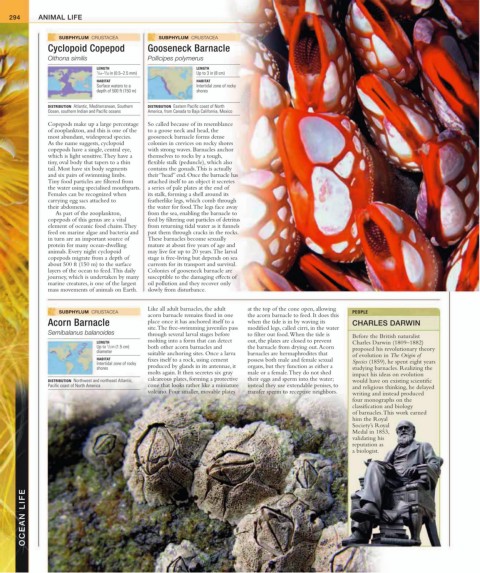
               Copepods make up a large percentage   So called because of its resemblance
               of zooplankton, and this is one of the   to a goose neck and head, the
               most abundant, widespread species.    gooseneck barnacle forms dense
               As the name suggests, cyclopoid   colonies in crevices on rocky shores
               copepods have a single, central eye,   with strong waves. Barnacles anchor
               which is light sensitive. They have a   themselves to rocks by a tough,
               tiny, oval body that tapers to a thin    flexible stalk (peduncle), which also
               tail. Most have six body segments    contains the gonads. This is actually
               and six pairs of swimming limbs.    their “head” end. Once the barnacle has
               Tiny food particles are filtered from   attached itself to an object it secretes
               the water using specialised mouthparts.  a series of pale plates at the end of
               Females can be recognized when   its stalk, forming a shell around its
               carrying egg sacs attached to    featherlike legs, which comb through
               their abdomens.               the water for food. The legs face away
                 As part of the zooplankton,   from the sea, enabling the barnacle to
               copepods of this genus are a vital   feed by filtering out particles of detritus
               element of oceanic food chains. They   from returning tidal water as it funnels
               feed on marine algae and bacteria and   past them through cracks in the rocks.
               in turn are an important source of   These barnacles become sexually
               protein for many ocean-dwelling   mature at about five years of age and
               animals. Every night cyclopoid   may live for up to 20 years. The larval
               copepods migrate from a depth of   stage is free-living but depends on sea
               about 500 ft (150 m) to the surface   currents for its transport and survival.
               layers of the ocean to feed. This daily   Colonies of gooseneck barnacle are
               journey, which is undertaken by many   susceptible to the damaging effects of
               marine creatures, is one of the largest   oil pollution and they recover only
               mass movements of animals on Earth.  slowly from disturbance.

                                             Like all adult barnacles, the adult   at the top of the cone open, allowing
                  SUBPHYLUM  CRUSTACEA                                                                    PEOPLE
                                             acorn barnacle remains fixed in one   the acorn barnacle to feed. It does this
               Acorn Barnacle                place once it has anchored itself to a   when the tide is in by waving its   CHARLES DARWIN
                                             site. The free-swimming juveniles pass   modified legs, called cirri, in the water
                                             through several larval stages before
               Semibalanus balanoides                                      to filter out food. When the tide is   Before the British naturalist
                              LENGTH         molting into a form that can detect   out, the plates are closed to prevent   Charles Darwin (1809–1882)
                                 1
                              Up to  / 2 in (1.5 cm)   both other acorn barnacles and   the barnacle from drying out. Acorn   proposed his revolutionary theory
                              diameter       suitable anchoring sites. Once a larva   barnacles are hermaphrodites that
                              HABITAT        fixes itself to a rock, using cement   possess both male and female sexual   of evolution in The Origin of
                              Intertidal zone of rocky                                                    Species (1859), he spent eight years
                              shores         produced by glands in its antennae, it   organs, but they function as either a   studying barnacles. Realizing the
                                             molts again. It then secretes six gray   male or a female. They do not shed   impact his ideas on evolution
               DISTRIBUTION  Northwest and northeast Atlantic,   calcareous plates, forming a protective   their eggs and sperm into the water;   would have on existing scientific
               Pacific coast of North America  cone that looks rather like a miniature   instead they use extendable penises, to   and religious thinking, he delayed
                                             volcano. Four smaller, movable plates   transfer sperm to receptive neighbors.  writing and instead produced
                                                                                                          four monographs on the
                                                                                                          classification and biology
                                                                                                          of barnacles. This work earned
                                                                                                          him the Royal
                                                                                                          Society’s Royal
                                                                                                          Medal in 1853,
                                                                                                          validating his
                                                                                                          reputation as
                                                                                                          a biologist.


        OCEAN LIFE

