


Page 292 - (DK) Ocean - The Definitive Visual Guide
P. 292
290     ANIMAL LIFE


               Arthropods


                                       THE ANIMALS THAT HAVE ACHIEVED the greatest diversity on
                   DOMAIN  Eucarya
                                       Earth are the arthropods, of which insects are by far the most
                  KINGDOM  Animalia
                                       numerous. However, most marine arthropods are crustaceans,
                   PHYLUM  Arthropoda
                                       such as crabs, shrimp, and barnacles. Crustaceans, including
                  SUBPHYLA  4
                                       both adults and larval stages, form most of the ocean’s
                   SPECIES  About 1.25 million
                                       zooplankton—the community of tiny, drifting life forms
               that support all oceanic food chains. Like land arthropods, all marine forms have
               an external skeleton, segmented body, and jointed appendages,  permitting some,
               such as robber crabs, to live on land as well as in water. Fully marine insects are
               rare but some live on seashores and coasts.

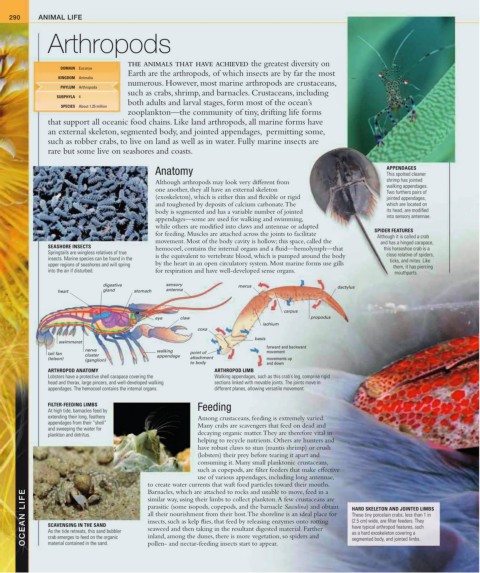
                                               Anatomy                                                              APPENDAGES
                                                                                                                    This spotted cleaner
                                               Although arthropods may look very different from                     shrimp has jointed
                                                                                                                    walking appendages.
                                               one another, they all have an external skeleton
                                                                                                                    Two furthers pairs of
                                               (exoskeleton), which is either thin and flexible or rigid            jointed appendages,
                                               and toughened by deposits of calcium carbonate. The                  which are located on
                                               body is segmented and has a variable number of jointed               its head, are modified
                                                                                                                    into sensory antennae.
                                               appendages—some are used for walking and swimming,
                                               while others are modified into claws and antennae or adapted
                                               for feeding. Muscles are attached across the joints to facilitate   SPIDER FEATURES
                                                                                                                 Although it is called a crab
                                               movement. Most of the body cavity is hollow; this space, called the   and has a hinged carapace,
               SEASHORE INSECTS                hemocoel, contains the internal organs and a fluid—hemolymph—that    this horseshoe crab is a
               Springtails are wingless relatives of true                                                           close relative of spiders,
               insects. Marine species can be found in the    is the equivalent to vertebrate blood, which is pumped around the body    ticks, and mites. Like
               upper regions of seashores and will spring    by the heart in an open circulatory system. Most marine forms use gills    them, it has piercing
               into the air if disturbed.      for respiration and have well-developed sense organs.                   mouthparts.

                                digestive         sensory               merus                        dactylus
                  heart         gland    stomach   antenna


                                                                                     carpus
                                               eye     claw                                  propodus
                                                                               ischium
                                                            coxa
                                                                             basis
                  swimmeret
                                                                                forward and backward
                          nerve                 walking                         movement
               tail fan   cluster               appendage  point of
               (telson)                                   attachment            movements up
                          (ganglion)
                                                          to body               and down
               ARTHROPOD ANATOMY                                 ARTHROPOD LIMB
               Lobsters have a protective shell carapace covering the    Walking appendages, such as this crab’s leg, comprise rigid
               head and thorax, large pincers, and well-developed walking   sections linked with movable joints. The joints move in
               appendages. The hemocoel contains the internal organs.  different planes, allowing versatile movement.
               FILTER-FEEDING LIMBS                         Feeding
               At high tide, barnacles feed by
               extending their long, feathery               Among crustaceans, feeding is extremely varied.
               appendages from their “shell”
               and sweeping the water for                   Many crabs are scavengers that feed on dead and
               plankton and detritus.                       decaying organic matter. They are therefore vital in
                                                            helping to recycle nutrients. Others are hunters and
                                                            have robust claws to stun (mantis shrimp) or crush
                                                            (lobsters) their prey before tearing it apart and
                                                            consuming it. Many small planktonic crustaceans,
                                                            such as copepods, are filter feeders that make effective
                                                            use of various appendages, including long antennae,
                                             to create water currents that waft food particles toward their mouths.
                                             Barnacles, which are attached to rocks and unable to move, feed in a
        OCEAN LIFE  SCAVENGING IN THE SAND   parasitic (some isopods, copepods, and the barnacle Sacculina) and obtain   HARD SKELETON AND JOINTED LIMBS
                                             similar way, using their limbs to collect plankton. A few crustaceans are
                                             all their nourishment from their host. The shoreline is an ideal place for
                                                                                                          These tiny porcelain crabs, less than 1 in
                                                                                                          (2.5 cm) wide, are filter feeders. They
                                             insects, such as kelp flies, that feed by releasing enzymes onto rotting
                                                                                                          have typical arthropod features, such
                                             seaweed and then taking in the resultant digested material. Farther
               As the tide retreats, this sand bubbler
                                                                                                          as a hard exoskeleton covering a
                                             inland, among the dunes, there is more vegetation, so spiders and
               crab emerges to feed on the organic
                                                                                                          segmented body, and jointed limbs.
                                             pollen- and nectar-feeding insects start to appear.
               material contained in the sand.

