


Page 299 - (DK) Ocean - The Definitive Visual Guide
P. 299
ARTHROPODS 297
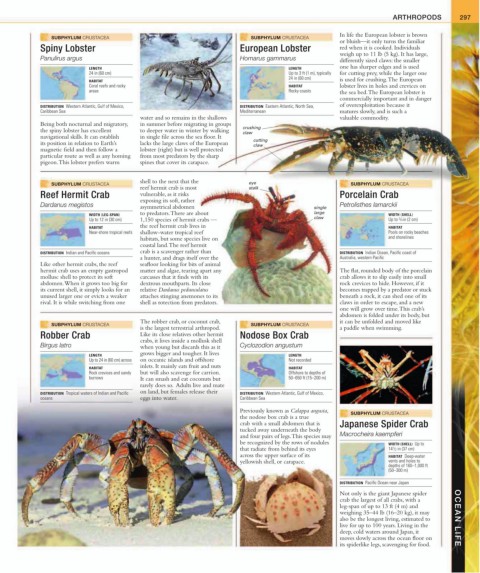
SUBPHYLUM CRUSTACEA SUBPHYLUM CRUSTACEA In life the European lobster is brown
or bluish—it only turns the familiar
Spiny Lobster European Lobster red when it is cooked. Individuals
weigh up to 11 lb (5 kg). It has large,
Panulirus argus Homarus gammarus differently sized claws: the smaller
LENGTH LENGTH one has sharper edges and is used
24 in (60 cm) Up to 3 ft (1 m), typically for cutting prey, while the larger one
24 in (60 cm)
HABITAT is used for crushing. The European
Coral reefs and rocky HABITAT lobster lives in holes and crevices on
areas Rocky coasts the sea bed. The European lobster is
commercially important and in danger
DISTRIBUTION Western Atlantic, Gulf of Mexico, DISTRIBUTION Eastern Atlantic, North Sea, of overexploitation because it
Caribbean Sea Mediterranean matures slowly, and is such a
water and so remains in the shallows valuable commodity.
Being both nocturnal and migratory, in summer before migrating in groups
the spiny lobster has excellent to deeper water in winter by walking crushing
claw
navigational skills. It can establish in single file across the sea floor. It
its position in relation to Earth’s lacks the large claws of the European cutting
claw
magnetic field and then follow a lobster (right) but is well protected
particular route as well as any homing from most predators by the sharp
pigeon. This lobster prefers warm spines that cover its carapace.
shell to the next that the
SUBPHYLUM CRUSTACEA eye SUBPHYLUM CRUSTACEA
reef hermit crab is most stalk
Reef Hermit Crab vulnerable, as it risks Porcelain Crab
exposing its soft, rather
asymmetrical abdomen
Dardanus megistos single Petrolisthes lamarckii
WIDTH (LEG-SPAN) to predators. There are about large WIDTH (SHELL)
Up to 12 in (30 cm) 1,150 species of hermit crabs — claw Up to 3 / 4 in (2 cm)
HABITAT the reef hermit crab lives in HABITAT
Near-shore tropical reefs shallow-water tropical reef Pools on rocky beaches
habitats, but some species live on and shorelines
coastal land. The reef hermit
DISTRIBUTION Indian and Pacific oceans crab is a scavenger rather than DISTRIBUTION Indian Ocean, Pacific coast of
a hunter, and drags itself over the Australia, western Pacific
Like other hermit crabs, the reef seafloor looking for bits of animal
hermit crab uses an empty gastropod matter and algae, tearing apart any The flat, rounded body of the porcelain
mollusc shell to protect its soft carcasses that it finds with its crab allows it to slip easily into small
abdomen. When it grows too big for dextrous mouthparts. Its close rock crevices to hide. However, if it
its current shell, it simply looks for an relative Dardanus pedunculatus becomes trapped by a predator or stuck
unused larger one or evicts a weaker attaches stinging anemones to its beneath a rock, it can shed one of its
rival. It is while switching from one shell as rotection from predators. claws in order to escape, and a new
one will grow over time. This crab’s
abdomen is folded under its body, but
The robber crab, or coconut crab, it can be unfolded and moved like
SUBPHYLUM CRUSTACEA SUBPHYLUM CRUSTACEA
is the largest terrestrial arthropod. a paddle when swimming.
Robber Crab Like its close relatives other hermit Nodose Box Crab
crabs, it lives inside a mollusk shell
when young but discards this as it
Birgus latro Cyclozodion angustum
LENGTH grows bigger and tougher. It lives LENGTH
Up to 24 in (60 cm) across on oceanic islands and offshore Not recorded
HABITAT inlets. It mainly eats fruit and nuts HABITAT
Rock crevices and sandy but will also scavenge for carrion. Offshore to depths of
burrows It can smash and eat coconuts but 50–650 ft (15–200 m)
rarely does so. Adults live and mate
DISTRIBUTION Tropical waters of Indian and Pacific on land, but females release their DISTRIBUTION Western Atlantic, Gulf of Mexico,
oceans eggs into water. Caribbean Sea
Previously known as Calappa angusta, SUBPHYLUM CRUSTACEA
the nodose box crab is a true
crab with a small abdomen that is Japanese Spider Crab
tucked away underneath the body
and four pairs of legs. This species may Macrocheira kaempferi
be recognized by the rows of nodules WIDTH (SHELL) Up to
that radiate from behind its eyes 14 1 / 2 in (37 cm)
across the upper surface of its HABITAT Deep-water
yellowish shell, or carapace. vents and holes to
depths of 160–1,000 ft
(50–300 m)
DISTRIBUTION Pacific Ocean near Japan
Not only is the giant Japanese spider
crab the largest of all crabs, with a
leg-span of up to 13 ft (4 m) and
weighing 35–44 lb (16–20 kg), it may
also be the longest living, estimated to OCEAN LIFE
live for up to 100 years. Living in the
deep, cold waters around Japan, it
moves slowly across the ocean floor on
its spiderlike legs, scavenging for food.

