


Page 294 - (DK) Ocean - The Definitive Visual Guide
P. 294
292
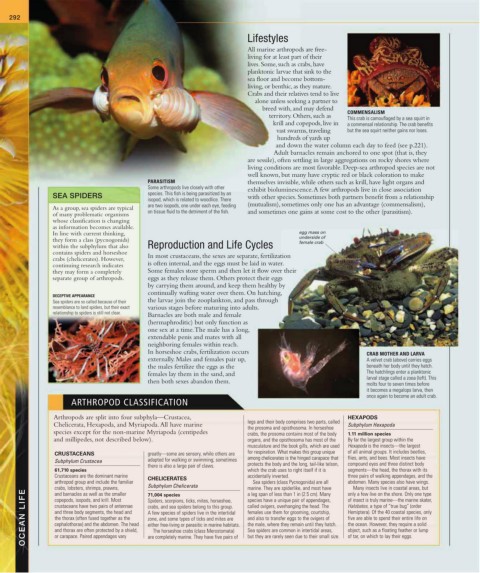
Lifestyles
All marine arthropods are free-
living for at least part of their
lives. Some, such as crabs, have
planktonic larvae that sink to the
sea floor and become bottom-
living, or benthic, as they mature.
Crabs and their relatives tend to live
alone unless seeking a partner to
breed with, and may defend
COMMENSALISM
territory. Others, such as
This crab is camouflaged by a sea squirt in
krill and copepods, live in a commensal relationship. The crab benefits
vast swarms, traveling but the sea squirt neither gains nor loses.
hundreds of yards up
and down the water column each day to feed (see p.221).
Adult barnacles remain anchored to one spot (that is, they
are sessile), often settling in large aggregations on rocky shores where
living conditions are most favorable. Deep-sea arthropod species are not
well known, but many have cryptic red or black coloration to make
PARASITISM themselves invisible, while others such as krill, have light organs and
Some arthropods live closely with other exhibit bioluminescence. A few arthropods live in close association
SEA SPIDERS species. This fish is being parasitized by an with other species. Sometimes both partners benefit from a relationship
isopod, which is related to woodlice. There
are two isopods, one under each eye, feeding (mutualism), sometimes only one has an advantage (commensalism),
As a group, sea spiders are typical
on tissue fluid to the detriment of the fish. and sometimes one gains at some cost to the other (parasitism).
of many problematic organisms
whose classification is changing
as information becomes available.
In line with current thinking, egg mass on
underside of
they form a class (pycnogonids) female crab
within the subphylum that also Reproduction and Life Cycles
contains spiders and horseshoe
crabs (chelicerates). However, In most crustaceans, the sexes are separate, fertilization
continuing research indicates is often internal, and the eggs must be laid in water.
they may form a completely Some females store sperm and then let it flow over their
separate group of arthropods. eggs as they release them. Others protect their eggs
by carrying them around, and keep them healthy by
continually wafting water over them. On hatching,
DECEPTIVE APPEARANCE
Sea spiders are so called because of their the larvae join the zooplankton, and pass through
resemblance to land spiders, but their exact various stages before maturing into adults.
relationship to spiders is still not clear.
Barnacles are both male and female
(hermaphroditic) but only function as
one sex at a time. The male has a long,
extendable penis and mates with all
neighboring females within reach.
In horseshoe crabs, fertilization occurs CRAB MOTHER AND LARVA
externally. Males and females pair up, A velvet crab (above) carries eggs
the males fertilize the eggs as the beneath her body until they hatch.
females lay them in the sand, and The hatchlings enter a planktonic
larval stage called a zoea (left). This
then both sexes abandon them.
molts four to seven times before
it becomes a megalops larva, then
once again to become an adult crab.
ARTHROPOD CLASSIFICATION
Arthropods are split into four subphyla—Crustacea,
legs and their body comprises two parts, called HEXAPODS
Chelicerata, Hexapoda, and Myriapoda. All have marine Subphylum Hexapoda
the prosoma and opisthosoma. In horseshoe
species except for the non-marine Myriapoda (centipedes crabs, the prosoma contains most of the body
and millipedes, not described below). organs, and the opisthosoma has most of the 1.11 million species
By far the largest group within the
musculature and the book gills, which are used Hexapoda is the insects—the largest
greatly—some are sensory, while others are for respiration. What makes this group unique of all animal groups. It includes beetles,
CRUSTACEANS among chelicerates is the hinged carapace that flies, ants, and bees. Most insects have
Subphylum Crustacea adapted for walking or swimming; sometimes
there is also a large pair of claws. protects the body and the long, tail-like telson, compound eyes and three distinct body
which the crab uses to right itself if it is segments—the head, the thorax with its
61,710 species
Crustaceans are the dominant marine accidentally inverted. three pairs of walking appendages, and the
arthropod group and include the familiar CHELICERATES Sea spiders (class Pycnogonida) are all abdomen. Many species also have wings.
crabs, lobsters, shrimps, prawns, Subphylum Chelicerata marine. They are spiderlike, and most have Many insects live in coastal areas, but
OCEAN LIFE crustaceans have two pairs of antennae crabs, and sea spiders belong to this group. called ovigers, overhanging the head. The Halobates, a type of “true bug” (order
and barnacles as well as the smaller
a leg span of less than 1 in (2.5 cm). Many
only a few live on the shore. Only one type
71,004 species
species have a unique pair of appendages,
copepods, isopods, and krill. Most
of insect is truly marine—the marine skater,
Spiders, scorpions, ticks, mites, horseshoe,
and three body segments, the head and
females use them for grooming, courtship,
Hemiptera). Of the 40 coastal species, only
A few species of spiders live in the intertidal
and also to transfer eggs to the ovigers of
five are able to spend their entire life on
the thorax (often fused together as the
zone, and some types of ticks and mites are
the ocean. However, they require a solid
the male, where they remain until they hatch.
cephalothorax) and the abdomen. The head
either free-living or parasitic in marine habitats.
object, such as a floating feather or lump
and thorax are often protected by a shield,
Sea spiders are common in intertidal areas,
The horseshoe crabs (class Merostomata)
but they are rarely seen due to their small size.
of tar, on which to lay their eggs.
or carapace. Paired appendages vary
are completely marine. They have five pairs of

