


Page 295 - (DK) Ocean - The Definitive Visual Guide
P. 295
ARTHROPODS          293


                SUBPHYLUM CHELICERATA         SUBPHYLUM CHELICERATA     the other five are for walking and for   HUMAN IMPACT
                                                                        grasping and tearing food. Five pairs
             Giant Sea Spider              American                     of flattened abdominal appendages are   MEDICAL
                                                                        used for swimming and scuttling along
                                           Horseshoe Crab                                               RESEARCH
             Colossendeis australis                                     the bottom and also carry pagelike
                           LENGTH 10 in ( 25 cm)                        “book gills,” through which oxygen is
                                           Limulus polyphemus
                           (leg-span)                                   absorbed. Its long, rigid tail is used for   If the American Horseshoe Crab
                                                         LENGTH  Up to 24 in                            is injured, some of its blood cells
                           WEIGHT  Not recorded                         steering and for righting itself. Hinged
                                                         (60 cm)                                        form a clot, which kills harmful
                           HABITAT  Bottom                              to the body, it can act as a lever.
                           dweller                       WEIGHT  Up to 11 lb (5 kg)  The reproductive cycle is closely   negative bacteria. In order to
                                                         HABITAT  Sandy or   linked to spring high tides, when adults   exploit this property for human
                                                         muddy bays to 100 ft
             DISTRIBUTION  Antarctic shelf and slope                    gather in large numbers on sandy   benefit, crabs are collected from
                                                         (30 m)
                                                                        beaches to breed. Females lay up to   shallow waters on the Atlantic
             Unlike most sea spiders, which have    DISTRIBUTION  Western Atlantic and Gulf Coast from   80,000 eggs in a depression near the   coast of North America during
                                           southern Maine to the Yucatán Peninsula
             a leg-span of less than 1 in (2.5 cm),                     high-tide mark, providing a vital food   the summer months. Researchers
             the giant sea spider has a huge                            source for birds and other marine   then remove about 20 percent
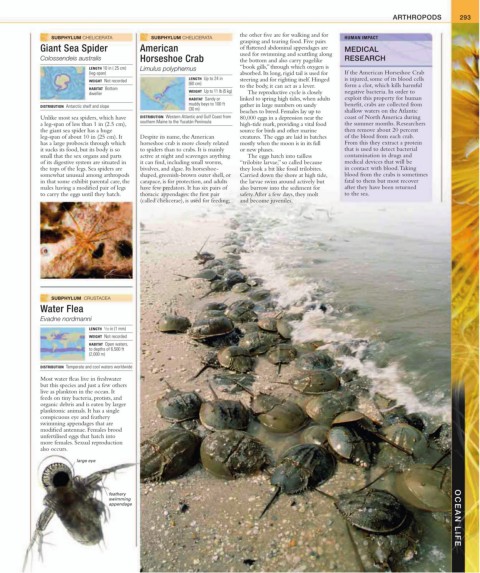
             leg-span of about 10 in (25 cm). It    Despite its name, the American   creatures.  The eggs are laid in batches   of the blood from each crab.
             has a large proboscis through which    horseshoe crab is more closely related   mostly when the moon is in its full    From this they extract a protein
             it sucks its food, but its body is so   to spiders than to crabs. It is mainly   or new phases.  that is used to detect bacterial
             small that the sex organs and parts    active at night and scavenges anything   The eggs hatch into tailless   contamination in drugs and
             of its digestive system are situated in   it can find, including small worms,   “trilobite larvae,” so called because   medical devices that will be
             the tops of the legs. Sea spiders are   bivalves, and algae. Its horseshoe-  they look a bit like fossil trilobites.   in contact with blood. Taking
             somewhat unusual among arthropods   shaped, greenish-brown outer shell, or   Carried down the shore at high tide,   blood from the crabs is sometimes
             in that some exhibit parental care, the   carapace, is for protection, and adults   the larvae swim around actively but   fatal to them but most recover
             males having a modified pair of legs    have few predators. It has six pairs of   also burrow into the sediment for   after they have been returned
             to carry the eggs until they hatch.  thoracic appendages: the first pair   safety. After a few days, they molt    to the sea.
                                           (called chelicerae), is used for feeding;   and become juveniles.


                SUBPHYLUM  CRUSTACEA
             Water Flea

             Evadne nordmanni
                           LENGTH   1 / 32 in (1 mm)
                           WEIGHT  Not recorded
                           HABITAT  Open waters,
                           to depths of 6,500 ft
                           (2,000 m)
             DISTRIBUTION  Temperate and cool waters worldwide
             Most water fleas live in freshwater
             but this species and just a few others
             live as plankton in the ocean. It
             feeds on tiny bacteria, protists, and
             organic debris and is eaten by larger
             planktonic animals. It has a single
             conspicuous eye and feathery
             swimming appendages that are
             modified antennae. Females brood
             unfertilised eggs that hatch into
             more females. Sexual reproduction
             also occurs.

                        large eye


                                 feathery
                                 swimming
                                 appendage                                                                                               OCEAN LIFE

