


Page 291 - (DK) Ocean - The Definitive Visual Guide
P. 291
MOLLUSKS 289
CLASS CEPHALOPODA
Australian Giant
Cuttlefish
Sepia apama
LENGTH
Up to 5 ft (1.5 m)
HABITAT
Shallow water over
reefs
DISTRIBUTION Coastal Australian waters
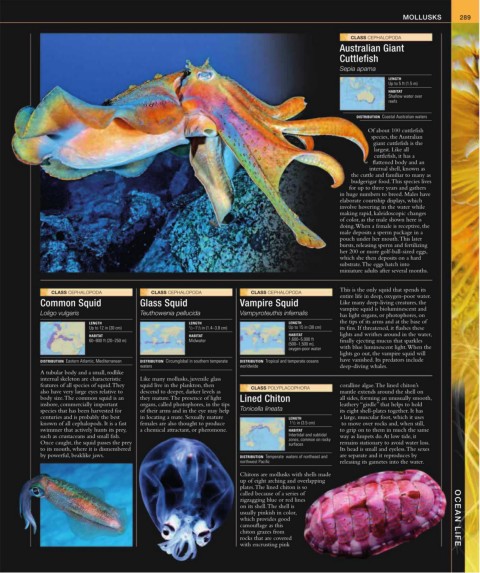
Of about 100 cuttlefish
species, the Australian
giant cuttlefish is the
largest. Like all
cuttlefish, it has a
flattened body and an
internal shell, known as
the cuttle and familiar to many as
budgerigar food. This species lives
for up to three years and gathers
in huge numbers to breed. Males have
elaborate courtship displays, which
involve hovering in the water while
making rapid, kaleidoscopic changes
of color, as the male shown here is
doing. When a female is receptive, the
male deposits a sperm package in a
pouch under her mouth. This later
bursts, releasing sperm and fertilizing
her 200 or more golf-ball-sized eggs,
which she then deposits on a hard
substrate. The eggs hatch into
miniature adults after several months.
CLASS CEPHALOPODA CLASS CEPHALOPODA CLASS CEPHALOPODA This is the only squid that spends its
entire life in deep, oxygen-poor water.
Common Squid Glass Squid Vampire Squid Like many deep-living creatures, the
vampire squid is bioluminescent and
Loligo vulgaris Teuthowenia pellucida Vampyroteuthis infernalis has light organs, or photophores, on
LENGTH LENGTH LENGTH the tips of its arms and at the base of
1
Up to 12 in (30 cm) 1 / 2–1 / 2 in (1.4–3.8 cm) Up to 15 in (38 cm) its fins. If threatened, it flashes these
HABITAT HABITAT HABITAT lights and writhes around in the water,
60–800 ft (20–250 m) Midwater 1,600–5,000 ft finally ejecting mucus that sparkles
(500–1,500 m),
oxygen-poor water with blue luminescent light. When the
lights go out, the vampire squid will
DISTRIBUTION Eastern Atlantic, Mediterranean DISTRIBUTION Circumglobal in southern temperate DISTRIBUTION Tropical and temperate oceans have vanished. Its predators include
waters worldwide deep-diving whales.
A tubular body and a small, rodlike
internal skeleton are characteristic Like many mollusks, juvenile glass
features of all species of squid. They squid live in the plankton, then CLASS POLYPLACOPHORA coralline algae. The lined chiton’s
also have very large eyes relative to descend to deeper, darker levels as mantle extends around the shell on
body size. The common squid is an they mature. The presence of light Lined Chiton all sides, forming an unusually smooth,
inshore, commercially important organs, called photophores, in the tips leathery “girdle” that helps to hold
species that has been harvested for of their arms and in the eye may help Tonicella lineata its eight shell-plates together. It has
centuries and is probably the best in locating a mate. Sexually mature LENGTH a large, muscular foot, which it uses
1
known of all cephalopods. It is a fast females are also thought to produce 1 / 2 in (3.5 cm) to move over rocks and, when still,
swimmer that actively hunts its prey, a chemical attractant, or pheromone. HABITAT to grip on to them in much the same
such as crustaceans and small fish. Intertidal and subtidal way as limpets do. At low tide, it
zones, common on rocky
Once caught, the squid passes the prey surfaces remains stationary to avoid water loss.
to its mouth, where it is dismembered Its head is small and eyeless. The sexes
by powerful, beaklike jaws. DISTRIBUTION Temperate waters of northeast and are separate and it reproduces by
northwest Pacific releasing its gametes into the water.
Chitons are mollusks with shells made
up of eight arching and overlapping
plates. The lined chiton is so
called because of a series of
zigzagging blue or red lines
on its shell. The shell is
usually pinkish in color,
which provides good OCEAN LIFE
camouflage as this
chiton grazes from
rocks that are covered
with encrusting pink

