


Page 303 - (DK) Ocean - The Definitive Visual Guide
P. 303
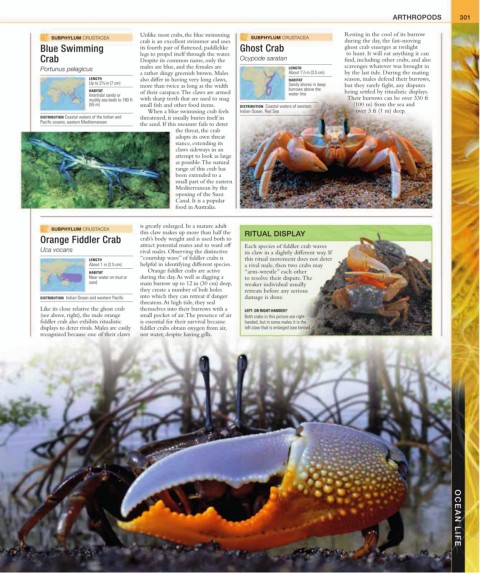
ARTHROPODS          301


                                           Unlike most crabs, the blue swimming                         Resting in the cool of its burrow
                SUBPHYLUM CRUSTACEA                                         SUBPHYLUM CRUSTACEA
                                           crab is an excellent swimmer and uses                        during the day, the fast-moving
             Blue Swimming                 its fourth pair of flattened, paddlelike   Ghost Crab        ghost crab emerges at twilight
                                                                                                         to hunt. It will eat anything it can
                                           legs to propel itself through the water.
             Crab                          Despite its common name, only the   Ocypode saratan          find, including other crabs, and also
                                           males are blue, and the females are         LENGTH           scavenges whatever was brought in
                                           a rather dingy greenish brown. Males        About 1 / 2 in (3.5 cm)  by the last tide. During the mating
             Portunus pelagicus                                                            1
                           LENGTH          also differ in having very long claws,      HABITAT          season, males defend their burrows,
                           Up to 2 / 4 in (7 cm)                                       Sandy shores in deep
                               3
                                           more than twice as long as the width                         but they rarely fight, any disputes
                           HABITAT         of their carapace. The claws are armed      burrows above the   being settled by ritualistic displays.
                           Intertidal sandy or                                         water line
                           muddy sea beds to 180 ft   with sharp teeth that are used to snag            Their burrows can be over 330 ft
                           (55 m)          small fish and other food items.   DISTRIBUTION  Coastal waters of western   (100 m) from the sea and
                                             When a blue swimming crab feels   Indian Ocean, Red Sea       over 3 ft (1 m) deep.
             DISTRIBUTION Coastal waters of the Indian and   threatened, it usually buries itself in
             Pacific oceans, eastern Mediterranean
                                           the sand. If this measure fails to deter
                                                     the threat, the crab
                                                     adopts its own threat
                                                     stance, extending its
                                                     claws sideways in an
                                                     attempt to look as large
                                                     as possible. The natural
                                                     range of this crab has
                                                     been extended to a
                                                     small part of the eastern
                                                     Mediterranean by the
                                                     opening of the Suez
                                                     Canal. It is a popular
                                                     food in Australia.
                                           is greatly enlarged. In a mature adult
                SUBPHYLUM CRUSTACEA
                                           this claw makes up more than half the   RITUAL DISPLAY
             Orange Fiddler Crab           crab’s body weight and is used both to
                                           attract potential mates and to ward off   Each species of fiddler crab waves
                                           rival males. Observing the distinctive
             Uca vocans                                                   its claw in a slightly different way. If
                                           “courtship wave” of fiddler crabs is
                           LENGTH                                         this ritual movement does not deter
                           About 1 in (2.5 cm)  helpful in identifying different species.    a rival male, then two crabs may
                                             Orange fiddler crabs are active
                           HABITAT                                        “arm-wrestle” each other
                           Near water on mud or   during the day. As well as digging a   to resolve their dispute. The
                           sand            main burrow up to 12 in (30 cm) deep,   weaker individual usually
                                           they create a number of bolt holes   retreats before any serious
                                           into which they can retreat if danger
             DISTRIBUTION  Indian Ocean and western Pacific                damage is done.
                                           threatens. At high tide, they seal
             Like its close relative the ghost crab   themselves into their burrows with a
                                                                          LEFT- OR RIGHT-HANDED?
             (see above, right), the male orange   small pocket of air. The presence of air   Both crabs in this picture are right-
             fiddler crab also exhibits ritualistic   is essential for their survival because   handed, but in some males it is the
             displays to deter rivals. Males are easily   fiddler crabs obtain oxygen from air,   left claw that is enlarged (see below).
             recognized because one of their claws   not water, despite having gills.                                                    OCEAN LIFE

