


Page 302 - (DK) Ocean - The Definitive Visual Guide
P. 302
300     ANIMAL LIFE


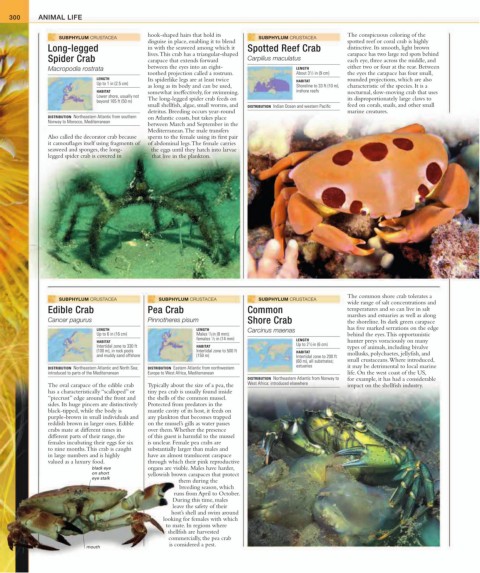
                  SUBPHYLUM CRUSTACEA        hook-shaped hairs that hold its   SUBPHYLUM CRUSTACEA      The conspicuous coloring of the
                                             disguise in place, enabling it to blend                    spotted reef or coral crab is highly
               Long-legged                   in with the seaweed among which it   Spotted Reef Crab     distinctive. Its smooth, light brown
                                             lives. This crab has a triangular-shaped                   carapace has two large red spots behind
               Spider Crab                   carapace that extends forward    Carpilius maculatus       each eye, three across the middle, and
                                             between the eyes into an eight-             LENGTH         either two or four at the rear. Between
                                                                                             1
                                             toothed projection called a rostrum.        About 3 / 2  in (9 cm)  the eyes the carapace has four small,
               Macropodia rostrata
                              LENGTH         Its spiderlike legs are at least twice      HABITAT        rounded projections, which are also
                              Up to 1 in (2.5 cm)
                                             as long as its body and can be used,        Shoreline to 33 ft (10 m),   characteristic of the species. It is a
                              HABITAT        somewhat ineffectively, for swimming.       inshore reefs   nocturnal, slow-moving crab that uses
                              Lower shore, usually not
                              beyond 165 ft (50 m)  The long-legged spider crab feeds on                its disproportionately large claws to
                                             small shellfish, algae, small worms, and   DISTRIBUTION  Indian Ocean and western Pacific   feed on corals, snails, and other small
                                             detritus. Breeding occurs year-round                       marine creatures.
               DISTRIBUTION  Northeastern Atlantic from southern   on Atlantic coasts, but takes place
               Norway to Morocco, Mediterranean
                                             between March and September in the
                                             Mediterranean. The male transfers
               Also called the decorator crab because   sperm to the female using its first pair
               it camouflages itself using fragments of   of abdominal legs. The female carries
               seaweed and sponges, the long-  the eggs until they hatch into larvae
               legged spider crab is covered in   that live in the plankton.


                  SUBPHYLUM CRUSTACEA           SUBPHYLUM CRUSTACEA           SUBPHYLUM CRUSTACEA       The common shore crab tolerates a
                                                                                                        wide range of salt concentrations and
               Edible Crab                   Pea Crab                      Common                       temperatures and so can live in salt
                                                                                                        marshes and estuaries as well as along
                                                                           Shore Crab
               Cancer pagurus                Pinnotheres pisum                                          the shoreline. Its dark green carapace
                              LENGTH                       LENGTH                                       has five marked serrations on the edge
                                                               1
                              Up to 6 in (16 cm)           Males  / 3 in (8 mm);   Carcinus maenas      behind the eyes. This opportunistic
                                                                1
                                                           females  / 2  in (14 mm)      LENGTH
                              HABITAT                                                                   hunter preys voraciously on many
                                                                                             1
                              Intertidal zone to 330 ft    HABITAT                       Up to 2 / 2 in (6 cm)  types of animals, including bivalve
                              (100 m), in rock pools       Intertidal zone to 500 ft     HABITAT
                              and muddy sand offshore      (150 m)                       Intertidal zone to 200 ft   mollusks, polychaetes, jellyfish, and
                                                                                         (60 m), all substrates;   small crustaceans. Where introduced,
                                                                                         estuaries      it may be detrimental to local marine
               DISTRIBUTION  Northeastern Atlantic and North Sea;   DISTRIBUTION  Eastern Atlantic from northwestern
               introduced to parts of the Mediterranean  Europe to West Africa, Mediterranean           life. On the west coast of the US,
                                                                           DISTRIBUTION  Northeastern Atlantic from Norway to   for example, it has had a considerable
               The oval carapace of the edible crab   Typically about the size of a pea, the   West Africa; introduced elsewhere   impact on the shellfish industry.
               has a characteristically “scalloped” or   tiny pea crab is usually found inside
               “piecrust” edge around the front and   the shells of the common mussel.
               sides. Its huge pincers are distinctively   Protected from predators in the
               black-tipped, while the body is   mantle cavity of its host, it feeds on
               purple-brown in small individuals and   any plankton that becomes trapped
               reddish brown in larger ones. Edible   on the mussel’s gills as water passes
               crabs mate at different times in   over them. Whether the presence
               different parts of their range, the   of this guest is harmful to the mussel
               females incubating their eggs for six    is unclear. Female pea crabs are
               to nine months. This crab is caught    substantially larger than males and
               in large numbers and is highly    have an almost translucent carapace
               valued as a luxury food.      through which their pink reproductive
                            black eye        organs are visible. Males have harder,
                            on short         yellowish brown carapaces that protect
                            eye stalk
                                                      them during the
                                                      breeding season, which
                                                     runs from April to October.
                                                    During this time, males
                                                    leave the safety of their
                                                    host’s shell and swim around
                                                  looking for females with which
                                                  to mate. In regions where
                                                   shellfish are harvested
                                                   commercially, the pea crab
                                                   is considered a pest.
                           mouth

