


Page 306 - (DK) Ocean - The Definitive Visual Guide
P. 306
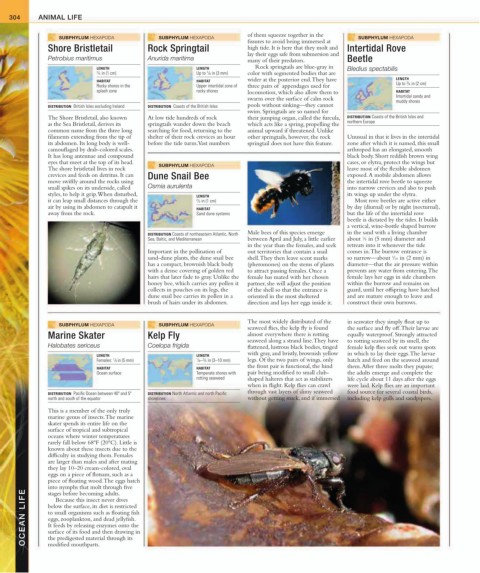
304     ANIMAL LIFE


                  SUBPHYLUM HEXAPODA            SUBPHYLUM HEXAPODA         of them squeeze together in the   SUBPHYLUM HEXAPODA
                                                                           fissures to avoid being immersed at
               Shore Bristletail             Rock Springtail               high tide. It is here that they molt and   Intertidal Rove
                                                                           lay their eggs safe from submersion and
               Petrobius maritimus           Anurida maritima              many of their predators.     Beetle
                              LENGTH                       LENGTH            Rock springtails are blue-gray in
                              2 / 5 in (1 cm)                  1                                        Bledius spectabilis
                                                           Up to  / 8 in (3 mm)  color with segmented bodies that are
                              HABITAT                      HABITAT         wider at the posterior end. They have       LENGTH
                                                                                                                          3
                              Rocky shores in the          Upper intertidal zone of   three pairs of  appendages used for   Up to  / 4 in (2 cm)
                              splash zone                  rocky shores    locomotion, which also allow them to        HABITAT
                                                                           swarm over the surface of calm rock         Intertidal sandy and
                                                                                                                       muddy shores
               DISTRIBUTION  British Isles excluding Ireland  DISTRIBUTION  Coasts of the British Isles  pools without sinking—they cannot
                                                                           swim. Springtails are so named for
               The Shore Bristletail, also known    At low tide hundreds of rock   their jumping organ, called the furcula,   DISTRIBUTION Coasts of the British Isles and
               as the Sea Bristletail, derives its   springtails wander down the beach   which acts like a spring, propelling the   northern Europe
               common name from the three long   searching for food, returning to the   animal upward if threatened. Unlike
               filaments extending from the tip of    shelter of their rock crevices an hour   other springtails, however, the rock   Unusual in that it lives in the intertidal
               its abdomen. Its long body is well-  before the tide turns. Vast numbers    springtail does not have this feature.  zone after which it is named, this small
               camouflaged by drab-colored scales.                                                      arthropod has an elongated, smooth
               It has long antennae and compound                                                        black body. Short reddish brown wing
               eyes that meet at the top of its head.    SUBPHYLUM HEXAPODA                             cases, or elytra, protect the wings but
               The shore bristletail lives in rock                                                      leave most of the flexible abdomen
               crevices and feeds on detritus. It can   Dune Snail Bee                                  exposed. A mobile abdomen allows
               move swiftly around the rocks using                                                      the intertidal rove beetle to squeeze
               small spikes on its underside, called   Osmia aurulenta                                  into narrow crevices and also to push
               styles, to help it grip. When disturbed,                                                 its wings up under the elytra.
                                                           LENGTH
               it can leap small distances through the     2 / 5 in (1 cm)                                 Most rove beetles are active either
               air by using its abdomen to catapult it                                                  by day (diurnal) or by night (nocturnal),
                                                           HABITAT
               away from the rock.                         Sand dune systems                            but the life of the intertidal rove
                                                                                                        beetle is dictated by the tides. It builds
                                                                                                        a vertical, wine-bottle shaped burrow
                                             DISTRIBUTION Coasts of northeastern Atlantic, North   Male bees of this species emerge   in the sand with a living chamber
                                                                                                             1
                                             Sea, Baltic, and Mediterranean   between April and July, a little earlier   about /5 in (5 mm) diameter and
                                                                           in the year than the females, and seek   retreats into it whenever the tide
                                             Important in the pollination of   out territories that contain a snail   comes in. The burrow entrance is
                                             sand-dune plants, the dune snail bee   shell. They then leave scent marks   so narrow—about / 10 in (2 mm) in
                                                                                                                      1
                                             has a compact, brownish black body   (pheromones) on the stems of plants   diameter—that the air pressure within
                                             with a dense covering of golden red   to attract passing females. Once a   prevents any water from entering. The
                                             hairs that later fade to gray. Unlike the   female has mated with her chosen   female lays her eggs in side chambers
                                             honey bee, which carries any pollen it   partner, she will adjust the position    within the burrow and remains on
                                             collects in pouches on its legs, the   of the shell so that the entrance is   guard, until her offspring have hatched
                                             dune snail bee carries its pollen in a   oriented in the most sheltered   and are mature enough to leave and
                                             brush of hairs under its abdomen.   direction and lays her eggs inside it.  construct their own burrows.
                                                                           The most widely distributed of the   in seawater they simply float up to
                  SUBPHYLUM HEXAPODA            SUBPHYLUM HEXAPODA
                                                                           seaweed flies, the kelp fly is found   the surface and fly off. Their larvae are
               Marine Skater                 Kelp Fly                      almost everywhere there is rotting   equally waterproof. Strongly attracted
                                                                           seaweed along a strand line. They have   to rotting seaweed by its smell, the
                                                                           flattened, lustrous black bodies, tinged
               Halobates sericeus            Coelopa frigida                                            female kelp flies seek out warm spots
                              LENGTH                       LENGTH          with gray, and bristly, brownish yellow   in which to lay their eggs. The larvae
                                                             2
                              Females:  / 5 in (5 mm)      1 / 8– / 5 in (3–10 mm)  legs. Of the two pairs of wings, only   hatch and feed on the seaweed around
                                   1
                              HABITAT                      HABITAT         the front pair is functional, the hind   them. After three molts they pupate;
                              Ocean surface                Temperate shores with   pair being modified to small club-  the adults emerge and complete the
                                                           rotting seaweed  shaped halteres that act as stabilizers   life cycle about 11 days after the eggs
                                                                           when in flight. Kelp flies can crawl   were laid. Kelp flies are an important
               DISTRIBUTION  Pacific Ocean between 40º and 5º   DISTRIBUTION North Atlantic and north Pacific   through vast layers of slimy seaweed   food source for several coastal birds,
               north and south of the equator   shorelines                 without getting stuck, and if immersed  including kelp gulls and sandpipers.
               This is a member of the only truly
               marine genus of insects. The marine
               skater spends its entire life on the
               surface of tropical and subtropical
               oceans where winter temperatures
               rarely fall below 68ºF (20ºC). Little is
               known about these insects due to the
               difficulty in studying them. Females
               are larger than males and after mating
               they lay 10–20 cream-colored, oval
               eggs on a piece of flotsam, such as a
               piece of floating wood. The eggs hatch
               into nymphs that molt through five
        OCEAN LIFE  below the surface, its diet is restricted
               stages before becoming adults.
                 Because this insect never dives
               to small organisms such as floating fish
               eggs, zooplankton, and dead jellyfish.
               It feeds by releasing enzymes onto the
               surface of its food and then drawing in
               the predigested material through its
               modified mouthparts.

