


Page 307 - (DK) Ocean - The Definitive Visual Guide
P. 307
BRYOZOANS         305


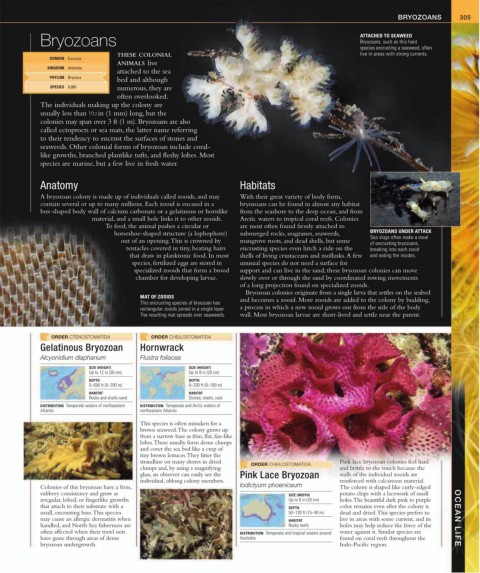
             Bryozoans                                                                                      ATTACHED TO SEAWEED
                                                                                                            Bryozoans, such as this hard
                                                                                                            species encrusting a seaweed, often
                                    THESE COLONIAL                                                          live in areas with strong currents.
                DOMAIN  Eucarya
                                    ANIMALS live
               KINGDOM Animalia
                                    attached to the sea
                PHYLUM Bryozoa
                                    bed and although
                SPECIES 6,085       numerous, they are
                                    often overlooked.
             The individuals making up the colony are
                           1
             usually less than  / 32 in (1 mm) long, but the
             colonies may span over 3 ft (1 m). Bryozoans are also
             called ectoprocts or sea mats, the latter name referring
             to their tendency to encrust the surfaces of stones and
             seaweeds. Other colonial forms of bryozoan include coral-
             like growths, branched plantlike tufts, and fleshy lobes. Most
             species are marine, but a few live in fresh water.


             Anatomy                                                    Habitats
             A bryozoan colony is made up of individuals called zooids, and may   With their great variety of body form,
             contain several or up to many millions. Each zooid is encased in a   bryozoans can be found in almost any habitat
             box-shaped body wall of calcium carbonate or a gelatinous or hornlike   from the seashore to the deep ocean, and from
                            material, and a small hole links it to other zooids.    Arctic waters to tropical coral reefs. Colonies
                                To feed, the animal pushes a circular or   are most often found firmly attached to
                                   horseshoe-shaped structure (a lophophore)   submerged rocks, seagrasses, seaweeds,   BRYOZOANS UNDER ATTACK
                                                                                                               Sea slugs often make a meal
                                     out of an opening. This is crowned by   mangrove roots, and dead shells, but some
                                                                                                               of encrusting bryozoans,
                                       tentacles covered in tiny, beating hairs   encrusting species even hitch a ride on the   breaking into each zooid
                                        that draw in planktonic food. In most   shells of living crustaceans and mollusks. A few   and eating the insides.
                                        species, fertilized eggs are stored in   unusual species do not need a surface for
                                         specialized zooids that form a brood   support and can live in the sand; these bryozoan colonies can move
                                         chamber for developing larvae.  slowly over or through the sand by coordinated rowing movements
                                                                        of a long projection found on specialized zooids.
                                                                           Bryozoan colonies originate from a single larva that settles on the seabed
                                           MAT OF ZOOIDS
                                           This encrusting species of bryozoan has   and becomes a zooid. More zooids are added to the colony by budding,
                                           rectangular zooids joined in a single layer.   a process in which a new zooid grows out from the side of the body
                                           The resulting mat spreads over seaweeds.  wall. Most bryozoan larvae are short-lived and settle near the parent.


                ORDER CTENOSTOMATIDA          ORDER CHEILOSTOMATIDA
             Gelatinous Bryozoan           Hornwrack

             Alcyonidium diaphanum         Flustra foliacea
                           SIZE (HEIGHT)                 SIZE (HEIGHT)
                           Up to 12 in (30 cm)           Up to 8 in (20 cm)
                           DEPTH                         DEPTH
                           0–656 ft (0–200 m)            0–330 ft (0–100 m)
                           HABITAT                       HABITAT
                           Rocks and shelly sand         Stones, shells, rock
             DISTRIBUTION  Temperate waters of northeastern   DISTRIBUTION  Temperate and Arctic waters of
             Atlantic                      northeastern Atlantic
                                           This species is often mistaken for a
                                           brown seaweed. The colony grows up
                                           from a narrow base as thin, flat, fan-like
                                           lobes. These usually form dense clumps
                                           and cover the sea bed like a crop of
                                           tiny brown lettuces. They litter the
                                           strandline on many shores in dried   ORDER CHEILOSTOMATIDA  Pink lace bryozoan colonies feel hard
                                           clumps and, by using a magnifying                          and brittle to the touch because the
                                           glass, an observer can easily see the   Pink Lace Bryozoan  walls of the individual zooids are
                                           individual, oblong colony members.                         reinforced with calcareous material.
             Colonies of this bryozoan have a firm,                     Iodictyum phoeniceum          The colony is shaped like curly-edged
             rubbery consistency and grow as                                           SIZE (WIDTH)     potato chips with a lacework of small
             irregular, lobed, or fingerlike growths                                   Up to 8 in (20 cm)   holes. The beautiful dark pink to purple
             that attach to their substrate with a                                     DEPTH          color remains even after the colony is
             small, encrusting base. This species                                      50–130 ft (15–40 m)  dead and dried. This species prefers to
             may cause an allergic dermatitis when                                     HABITAT        live in areas with some current, and its   OCEAN LIFE
             handled, and North Sea fishermen are                                      Rocky reefs    holes may help reduce the force of the
             often affected when their trawl nets                       DISTRIBUTION  Temperate and tropical waters around   water against it. Similar species are
             have gone through areas of dense                           Australia                     found on coral reefs throughout the
             bryozoan undergrowth.                                                                    Indo-Pacific region.

