


Page 305 - (DK) Ocean - The Definitive Visual Guide
P. 305
303


                                     Red Crab Migration


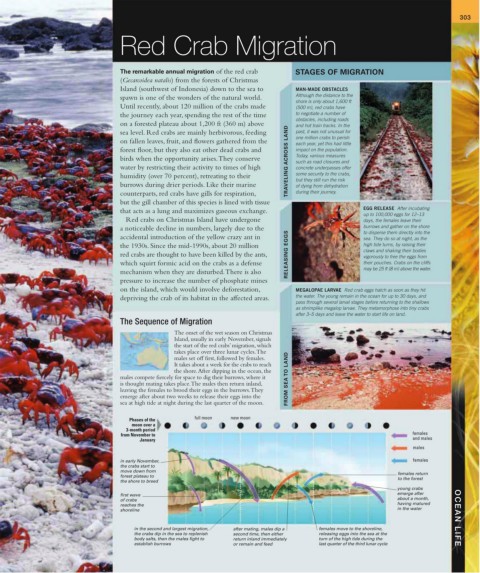
                                     The remarkable annual migration of the red crab
                                                                                         STAGES OF MIGRATION
                                     (Gecarcoidea natalis) from the forests of Christmas
                                     Island (southwest of Indonesia) down to the sea to   MAN-MADE OBSTACLES
                                     spawn is one of the wonders of the natural world.   Although the distance to the
                                                                                         shore is only about 1,600 ft
                                     Until recently, about 120 million of the crabs made   (500 m), red crabs have
                                     the journey each year, spending the rest of the time   to negotiate a number of
                                                                                         obstacles, including roads
                                     on a forested plateau about 1,200 ft (360 m) above   and hot train tracks. In the
                                     sea level. Red crabs are mainly herbivorous, feeding    past, it was not unusual for
                                     on fallen leaves, fruit, and flowers gathered from the   one million crabs to perish
                                                                                         each year, yet this had little
                                     forest floor, but they also eat other dead crabs and   impact on the population.
                                     birds when the opportunity arises. They conserve   TRAVELING ACROSS LAND  Today, various measures
                                                                                         such as road closures and
                                     water by restricting their activity to times of high   concrete underpasses offer
                                     humidity (over 70 percent), retreating to their     some security to the crabs,
                                                                                         but they still run the risk
                                     burrows during drier periods. Like their marine     of dying from dehydration
                                     counterparts, red crabs have gills for respiration,    during their journey.
                                     but the gill chamber of this species is lined with tissue
                                                                                                             EGG RELEASE  After incubating
                                     that acts as a lung and maximizes gaseous exchange.
                                                                                                             up to 100,000 eggs for 12–13
                                      Red crabs on Christmas Island have undergone                           days, the females leave their
                                     a noticeable decline in numbers, largely due to the                     burrows and gather on the shore
                                                                                                             to disperse them directly into the
                                     accidental introduction of the yellow crazy ant in                      sea. They do so at night, as the
                                     the 1930s. Since the mid-1990s, about 20 million                        high tide turns, by raising their
                                                                                                             claws and shaking their bodies
                                     red crabs are thought to have been killed by the ants,   RELEASING EGGS   vigorously to free the eggs from
                                     which squirt formic acid on the crabs as a defense                      their pouches. Crabs on the cliffs
                                     mechanism when they are disturbed. There is also                        may be 25 ft (8 m) above the water.
                                     pressure to increase the number of phosphate mines
                                     on the island, which would involve deforestation,   MEGALOPAE LARVAE  Red crab eggs hatch as soon as they hit
                                     depriving the crab of its habitat in the affected areas.  the water. The young remain in the ocean for up to 30 days, and
                                                                                         pass through several larval stages before returning to the shallows
                                                                                         as shrimplike megalop larvae. They metamorphose into tiny crabs
                                                                                         after 3–5 days and leave the water to start life on land.
                                     The Sequence of Migration

                                                     The onset of the wet season on Christmas
                                                     Island, usually in early November, signals
                                                     the start of the red crabs’ migration, which
                                                     takes place over three lunar cycles. The
                                                     males set off first, followed by females.
                                                     It takes about a week for the crabs to reach
                                                     the shore. After dipping in the ocean, the
                                     males compete fiercely for space to dig their burrows, where it    FROM SEA TO LAND
                                     is thought mating takes place. The males then return inland,
                                     leaving the females to brood their eggs in the burrows. They
                                     emerge after about two weeks to release their eggs into the
                                     sea at high tide at night during the last quarter of the moon.

                                                           full moon  new moon
                                       Phases of the
                                        moon over a
                                      3-month period
                                     from November to                                                                       females
                                           January                                                                          and males
                                                                                                                            males
                                     in early November,                                                                     females
                                     the crabs start to
                                     move down from                                                                    females return
                                     forest plateau to
                                     the shore to breed                                                                to the forest
                                                                                                                       young crabs
                                     first wave                                                                         emerge after
                                     of crabs                                                                          about a month,
                                     reaches the                                                                       having matured
                                     shoreline                                                                         in the water      OCEAN LIFE

                                         in the second and largest migration,   after mating, males dip a   females move to the shoreline,
                                         the crabs dip in the sea to replenish   second time, then either   releasing eggs into the sea at the
                                         body salts, then the males fight to   return inland immediately   turn of the high tide during the
                                         establish burrows            or remain and feed        last quarter of the third lunar cycle

