


Page 33 - (DK) Ocean - The Definitive Visual Guide
P. 33
THE PROPERTIES OF WATER             31


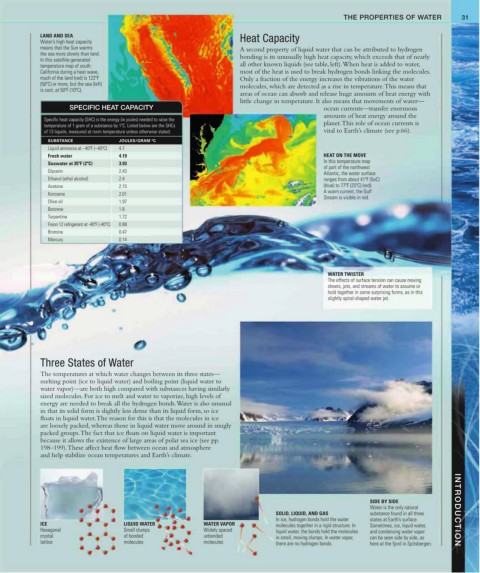
             LAND AND SEA                                               Heat Capacity
             Water’s high heat capacity
             means that the Sun warms                                   A second property of liquid water that can be attributed to hydrogen
             the sea more slowly than land.
             In this satellite-generated                                bonding is its unusually high heat capacity, which exceeds that of nearly
             temperature map of south                                   all other known liquids (see table, left). When heat is added to water,
             California during a heat wave,                             most of the heat is used to break hydrogen bonds linking the molecules.
             much of the land (red) is 122ºF                            Only a fraction of the energy increases the vibrations of the water
             (50ºC) or more, but the sea (left)                         molecules, which are detected as a rise in temperature. This means that
             is cool, at 50ºF (10ºC).
                                                                        areas of ocean can absorb and release huge amounts of heat energy with
                                                                        little change in temperature. It also means that movements of water—
                      SPECIFIC HEAT CAPACITY                                                     ocean currents—transfer enormous
                                                                                                 amounts of heat energy around the
              Specific heat capacity (SHC) is the energy (in joules) needed to raise the
              temperature of 1 gram of a substance by 1ºC. Listed below are the SHCs             planet. This role of ocean currents is
              of 13 liquids, measured at room temperature unless otherwise stated.               vital to Earth’s climate (see p.66).
               SUBSTANCE            JOULES/GRAM ºC
               Liquid ammonia at –40ºF (–40ºC)  4.7
               Fresh water          4.19                                                         HEAT ON THE MOVE
                                                                                                 In this temperature map
               Seawater at 35ºF (2ºC)  3.93
                                                                                                 of part of the northwest
               Glycerin             2.43
                                                                                                 Atlantic, the water surface
               Ethanol (ethyl alcohol)  2.4                                                      ranges from about 41ºF (5oC)
               Acetone              2.15                                                         (blue) to 77ºF (25ºC) (red).
                                                                                                 A warm current, the Gulf
               Kerosene             2.01
                                                                                                 Stream is visible in red.
               Olive oil            1.97
               Benzene              1.8
               Turpentine           1.72
               Freon 12 refrigerant at -40ºF (-40ºC)  0.88
               Bromine              0.47
               Mercury              0.14


                                                                                                   WATER TWISTER
                                                                                                   The effects of surface tension can cause moving
                                                                                                   sheets, jets, and streams of water to assume or
                                                                                                   hold together in some surprising forms, as in this
                                                                                                   slightly spiral-shaped water jet.


             Three States of Water
             The temperatures at which water changes between its three states—
             melting point (ice to liquid water) and boiling point (liquid water to
             water vapor)—are both high compared with substances having similarly
             sized molecules. For ice to melt and water to vaporize, high levels of
             energy are needed to break all the hydrogen bonds. Water is also unusual
             in that its solid form is slightly less dense than its liquid form, so ice
             floats in liquid water. The reason for this is that the molecules in ice
             are loosely packed, whereas those in liquid water move around in snugly
             packed groups. The fact that ice floats on liquid water is important
             because it allows the existence of large areas of polar sea ice (see pp.
             198–199). These affect heat flow between ocean and atmosphere
             and help stabilize ocean temperatures and Earth’s climate.


                                                                                                               SIDE BY SIDE
                                                                                                               Water is the only natural   INTRODUCTION
                                                                                   SOLID, LIQUID, AND GAS      substance found in all three
                                                                                   In ice, hydrogen bonds hold the water   states at Earth’s surface.
             ICE                      LIQUID WATER            WATER VAPOR          molecules together in a rigid structure. In   Sometimes, ice, liquid water,
             Hexagonal                Small clumps            Widely spaced        liquid water, the bonds hold the molecules   and condensing water vapor
             crystal                  of bonded               unbonded             in small, moving clumps. In water vapor,   can be seen side by side, as
             lattice                  molecules               molecules            there are no hydrogen bonds.  here at the fjord in Spitsbergen.

