


Page 35 - (DK) Ocean - The Definitive Visual Guide
P. 35
THE CHEMISTRY OF SEAWATER              33


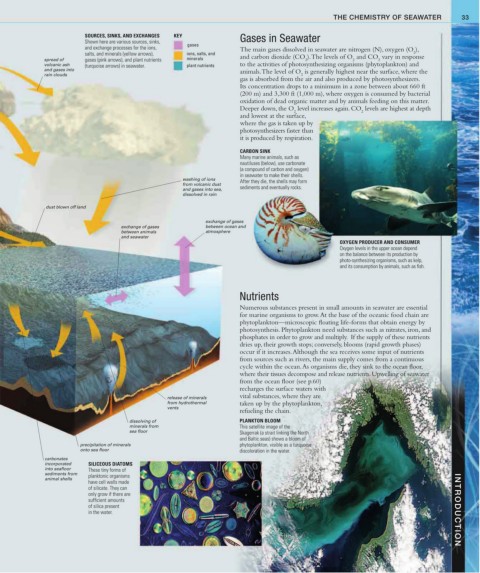
                          SOURCES, SINKS, AND EXCHANGES  KEY            Gases in Seawater
                          Shown here are various sources, sinks,   gases
                          and exchange processes for the ions,          The main gases dissolved in seawater are nitrogen (N), oxygen (O ),
                          salts, and minerals (yellow arrows),   ions, salts, and                                           2
                                                                                            2
              spread of   gases (pink arrows), and plant nutrients   minerals  and carbon dioxide (CO ). The levels of O  and CO  vary in response
                                                                                                                  2
                                                                                                          2
              volcanic ash   (turquoise arrows) in seawater.  plant nutrients  to the activities of photosynthesizing organisms (phytoplankton) and
              and gases into                                            animals. The level of O  is generally highest near the surface, where the
              rain clouds                                                                  2
                                                                        gas is absorbed from the air and also produced by photosynthesizers.
                                                                        Its concentration drops to a minimum in a zone between about 660 ft
                                                                        (200 m) and 3,300 ft (1,000 m), where oxygen is consumed by bacterial
                                                                        oxidation of dead organic matter and by animals feeding on this matter.
                                                                        Deeper down, the O  level increases again. CO  levels are highest at depth
                                                                                         2                   2
                                                                        and lowest at the surface,
                                                                        where the gas is taken up by
                                                                        photosynthesizers faster than
                                                                        it is produced by respiration.
                                                                        CARBON SINK
                                                                        Many marine animals, such as
                                                                        nautiluses (below), use carbonate
                                                                        (a compound of carbon and oxygen)
                                                                        in seawater to make their shells.
                                                       washing of ions   After they die, the shells may form
                                                       from volcanic dust
                                                       and gases into sea,   sediments and eventually rocks.
                                                       dissolved in rain
               dust blown off land

                                                              exchange of gases
                                     exchange of gases        between ocean and
                                     between animals          atmosphere
                                     and seawater
                                                                                                      OXYGEN PRODUCER AND CONSUMER
                                                                                                      Oxygen levels in the upper ocean depend
                                                                                                      on the balance between its production by
                                                                                                      photo-synthesizing organisms, such as kelp,
                                                                                                      and its consumption by animals, such as fish.


                                                                        Nutrients

                                                                        Numerous substances present in small amounts in seawater are essential
                                                                        for marine organisms to grow. At the base of the oceanic food chain are
                                                                        phytoplankton—microscopic floating life-forms that obtain energy by
                                                                        photosynthesis. Phytoplankton need substances such as nitrates, iron, and
                                                                        phosphates in order to grow and multiply.  If the supply of these nutrients
                                                                        dries up, their growth stops; conversely, blooms (rapid growth phases)
                                                                        occur if it increases. Although the sea receives some input of nutrients
                                                                        from sources such as rivers, the main supply comes from a continuous
                                                                        cycle within the ocean. As organisms die, they sink to the ocean floor,
                                                                        where their tissues decompose and release nutrients. Upwelling of seawater
                                                                        from the ocean floor (see p.60)
                                                                        recharges the surface waters with
                                                                        vital substances, where they are
                                                   release of minerals
                                                   from hydrothermal    taken up by the phytoplankton,
                                                   vents
                                                                        refueling the chain.
                                       dissolving of                    PLANKTON BLOOM
                                       minerals from                    This satellite image of the
                                       sea floor                         Skagerrak (a strait linking the North
                                                                        and Baltic seas) shows a bloom of
                         precipitation of minerals                      phytoplankton, visible as a turquoise
                         onto sea floor                                  discoloration in the water.
              carbonates
              incorporated    SILICEOUS DIATOMS
              into seafloor   These tiny forms of
              sediments from   planktonic organisms
              animal shells
                           have cell walls made
                           of silicate. They can
                           only grow if there are
                           sufficient amounts
                           of silica present
                           in the water.                                                                                                 INTRODUCTION

