


Page 37 - (DK) Ocean - The Definitive Visual Guide
P. 37
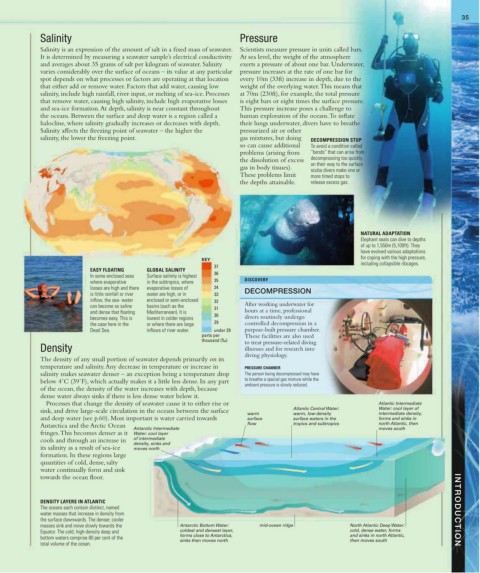
35


             Salinity                                                   Pressure

             Salinity is an expression of the amount of salt in a fixed mass of seawater.  Scientists measure pressure in units called bars.
             It is determined by measuring a seawater sample’s electrical conductivity  At sea level, the weight of the atmosphere
             and averages about 35 grams of salt per kilogram of seawater. Salinity   exerts a pressure of about one bar. Underwater,
             varies considerably over the surface of oceans – its value at any particular  pressure increases at the rate of one bar for
             spot depends on what processes or factors are operating at that location   every 10m (33ft) increase in depth, due to the
             that either add or remove water. Factors that add water, causing low   weight of the overlying water. This means that
             salinity, include high rainfall, river input, or melting of sea-ice. Processes   at 70m (230ft), for example, the total pressure
             that remove water, causing high salinity, include high evaporative losses   is eight bars or eight times the surface pressure.
             and sea-ice formation. At depth, salinity is near constant throughout    This pressure increase poses a challenge to
             the oceans. Between the surface and deep water is a region called a   human exploration of the oceans. To inflate
             halocline, where salinity gradually increases or decreases with depth.   their lungs underwater, divers have to breathe
             Salinity affects the freezing point of seawater – the higher the    pressurized air or other
             salinity, the lower the freezing point.                    gas mixtures, but doing   DECOMPRESSION STOP
                                                                        so can cause additional   To avoid a condition called
                                                                        problems (arising from   “bends” that can arise from
                                                                        the dissolution of excess   decompressing too quickly,
                                                                        gas in body tissues).   on their way to the surface
                                                                                              scuba divers make one or
                                                                        These problems limit   more timed stops to
                                                                        the depths attainable.  release excess gas.


                                                                                                            NATURAL ADAPTATION
                                                                                                            Elephant seals can dive to depths
                                                                                                            of up to 1,550m (5,100ft). They
                                                                                                            have evolved various adaptations
                                                                                                            for coping with the high pressure,
                                                             KEY
                                                                                                            including collapsible ribcages.
                                                                 37
                            EASY FLOATING    GLOBAL SALINITY
                                                                 36
                            In some enclosed seas   Surface salinity is highest
                            where evaporative    in the subtropics, where   35  DISCOVERY
                            losses are high and there   evaporative losses of   34  DECOMPRESSION
                            is little rainfall or river   water are high, or in   33
                            inflow, the sea- water   enclosed or semi-enclosed   32
                            can become so saline   basins (such as the    After working underwater for
                                                                 31
                            and dense that floating   Mediterranean). It is   hours at a time, professional
                                                                 30
                            becomes easy. This is    lowest in colder regions    divers routinely undergo
                                                                 29
                            the case here in the    or where there are large   controlled decompression in a
                            Dead Sea.        inflows of river water.  under 29  purpose-built pressure chamber.
                                                             parts per    These facilities are also used
                                                             thousand (‰)  to treat pressure-related diving
             Density                                                      illnesses and for research into
                                                                          diving physiology.
             The density of any small portion of seawater depends primarily on its
             temperature and salinity. Any decrease in temperature or increase in   PRESSURE CHAMBER
             salinity makes seawater denser – an exception being a temperature drop   The person being decompressed may have
             below 4˚C (39˚F), which actually makes it a little less dense. In any part   to breathe a special gas mixture while the
                                                                          ambient pressure is slowly reduced.
             of the ocean, the density of the water increases with depth, because
             dense water always sinks if there is less dense water below it.
               Processes that change the density of seawater cause it to either rise or                           Atlantic Intermediate
             sink, and drive large-scale circulation in the oceans between the surface   Atlantic Central Water:   Water: cool layer of
                                                                           warm         warm, low-density         intermediate density,
             and deep water (see p.60). Most important is water carried towards   surface    surface waters in the   forms and sinks in
             Antarctica and the Arctic Ocean                               flow          tropics and subtropics    north Atlantic, then
                                         Antarctic Intermediate                                                   moves south
             fringes. This becomes denser as it  Water: cool layer
             cools and through an increase in   of intermediate
                                         density, sinks and
             its salinity as a result of sea-ice   moves north
             formation. In these regions large
             quantities of cold, dense, salty
             water continually form and sink
             towards the ocean floor.
             DENSITY LAYERS IN ATLANTIC
             The oceans each contain distinct, named                                                                                     INTRODUCTION
             water masses that increase in density from
             the surface downwards. The denser, cooler
             masses sink and move slowly towards the   Antarctic Bottom Water:   mid-ocean ridge         North Atlantic Deep Water:
             Equator. The cold, high-density deep and   coldest and densest layer,                       cold, dense water, forms
             bottom waters comprise 80 per cent of the   forms close to Antarctica,                      and sinks in north Atlantic,
                                                       sinks then moves north
                                                                                                         then moves south
             total volume of the ocean.

