


Page 36 - (DK) Ocean - The Definitive Visual Guide
P. 36
34      OCEAN WATER


               Temperature and Salinity


               OCEAN WATER IS NOT UNIFORM BUT VARIES in several physical attributes,
               including temperature, salinity, pressure, and density. These vary vertically
               (dividing the oceans into layers), horizontally (between tropical and temperate
               regions, for example), and seasonally. The basic variables, temperature and salinity,
               in turn produce variations in density that help drive deep-water ocean circulation.


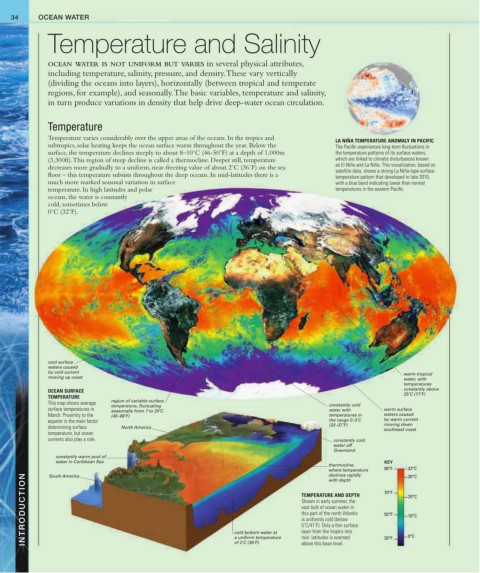
               Temperature
               Temperature varies considerably over the upper areas of the oceans. In the tropics and   LA NIÑA TEMPERATURE ANOMALY IN PACIFIC
               subtropics, solar heating keeps the ocean surface warm throughout the year. Below the    The Pacific experiences long-term fluctuations in
               surface, the temperature declines steeply to about 8–10˚C (46-50˚F) at a depth of 1,000m   the temperature patterns of its surface waters,
               (3,300ft). This region of steep decline is called a thermocline. Deeper still, temperature    which are linked to climatic disturbances known
               decreases more gradually to a uniform, near-freezing value of about 2˚C (36˚F) on the sea    as El Niño and La Niña. This visualization, based on
                                                                                                     satellite data, shows a strong La Niña-type surface
               floor – this temperature subsists throughout the deep oceans. In mid-latitudes there is a    temperature pattern that developed in late 2010,
               much more marked seasonal variation in surface                                        with a blue band indicating lower than normal
               temperature. In high latitudes and polar                                              temperatures in the eastern Pacific.
               oceans, the water is constantly
               cold, sometimes below
               0˚C (32˚F).


               cool surface
               waters caused
               by cold current                                                                                           warm tropical
               moving up coast
                                                                                                                         water, with
                                                                                                                         temperatures
                                                                                                                         constantly above
               OCEAN SURFACE
                                                                                                                         25˚C (77˚F)
               TEMPERATURE
               This map shows average   region of variable surface                                 constantly cold
                                  temperature, fluctuating
               surface temperatures in   seasonally from 7 to 20˚C                                 water with      warm surface
               March. Proximity to the   (45–68˚F)                                                 temperatures in   waters caused
               equator is the main factor                                                          the range 0–3˚C   by warm current
               determining surface   North America                                                 (32–37˚F)       moving down
                                                                                                                   southeast coast
               temperature, but ocean
               currents also play a role.                                                           constantly cold
                                                                                                    water off
                                                                                                    Greenland
                 constantly warm pool of
                 water in Caribbean Sea
                                                                                                   thermocline,    KEY
                                                                                                   where temperature   90°F  32°C
                                                                                                   declines rapidly
        INTRODUCTION                                                   cold bottom water at    TEMPERATURE AND DEPTH  70°F  20°C
               South America
                                                                                                                           30°C
                                                                                                   with depth
                                                                                           Shown in early summer, the
                                                                                           vast bulk of ocean water in
                                                                                           this part of the north Atlantic
                                                                                                                   50°F
                                                                                                                           10°C
                                                                                           is uniformly cold (below
                                                                                           5˚C/41˚F). Only a thin surface
                                                                                           layer from the tropics into
                                                                                                                           0°C
                                                                       a uniform temperature
                                                                                           mid- latitudes is warmed
                                                                                                                   30°F
                                                                       of 2˚C (36˚F)
                                                                                           above this base level.

