


Page 34 - (DK) Ocean - The Definitive Visual Guide
P. 34
32      OCEAN WATER


               The Chemistry of Seawater

                                                                                                                              volcanic ash drifts
                                                                                                                              down to sea
               THE OCEANS CONTAIN MILLIONS OF DISSOLVED chemical substances. Most of
               these are present in exceedingly small concentrations. Those present in significant
               concentrations include sea salt, which is not a single substance but a mixture
               of charged particles called ions. Other constituents include gases such
               as oxygen and carbon dioxide. One reason the oceans contain so
               many dissolved substances is that water is an excellent solvent.


               The Salty Sea                                                     salts are leached
                                                                                 from rocks into rivers
                                                                                 and streams and
               The salt in the oceans exists in the form of charged              flow to ocean              salt spray
                                                                                                           onto land
               particles, called ions, some positively charged and some
                                                                      nutrients from
               negatively charged. The most common of these are sodium   soil wash into
               and chloride ions, the components of ordinary table salt   rivers and streams,
                                                                      and flow to ocean
               (sodium chloride). Together they make up about 85 percent
               by mass of all the salt in the sea. Nearly all the rest is made
               up of the next four most common ions, which are sulfate,
               magnesium, calcium, and potassium. All these ions, together
               with several others present in smaller quantities, exist
               throughout the oceans in fixed proportions. Each is
               distributed extremely uniformly—this is in contrast to
               some other dissolved substances in seawater, which are
               unevenly distributed.

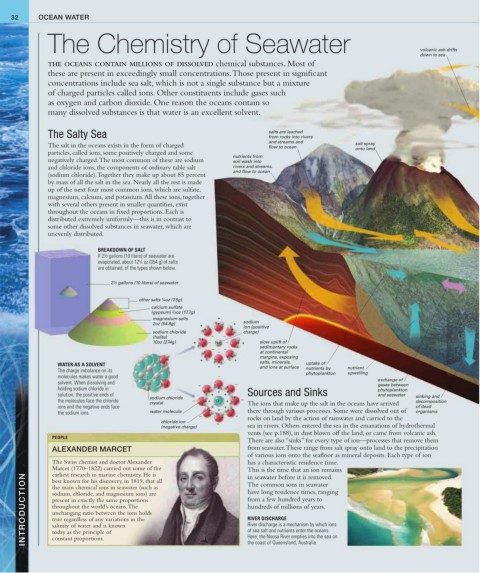
                              BREAKDOWN OF SALT
                              If 2½ gallons (10 liters) of seawater are
                              evaporated, about 12 / 4 oz (354 g) of salts
                                          3
                              are obtained, of the types shown below.
                                  2½ gallons (10 liters) of seawater


                                          other salts  1 /4oz (7.5g)
                                              calcium sulfate
                                              (gypsum)  2 /3oz (17.7g)
                                              magnesium salts     +
                                              2oz (54.8g)             +  sodium
                                                             +           ion (positive
                                              sodium chloride     –      charge)
                                              (halite)          –   –
                                              10oz (274g)  +   –  Na +  –  +  slow uplift of
                                                                              sedimentary rocks
                                                                –   –
                                                                  –           at continental
                                                                              margins, exposing
                                                             +         +
                  WATER AS A SOLVENT                                          salts, minerals,   uptake of
                                                                  +           and ions at surface       nutrient
                  The charge imbalance on its                                               nutrients by
                                                                                            phytoplankton  upwelling
                  molecules makes water a good                    –
                                                                                                                 exchange of
                  solvent. When dissolving and
                                                            –          –                                         gases between
                  holding sodium chloride in                                                                     phytoplankton
                                                                  +        Sources and Sinks
                  solution, the positive ends of                +   +                                            and seawater
                                             sodium chloride                                                                 sinking and
                  the molecules face the chloride         –    +  Cl –  +  –                                                 decomposition
                                             crystal                       The ions that make up the salt in the oceans have arrived
                  ions and the negative ends face               +   +                                                        of dead
                  the sodium ions.            water molecule      +        there through various processes. Some were dissolved out of   organisms
                                                            –          –   rocks on land by the action of rainwater and carried to the
                                                 chloride ion     –
                                                 (negative charge)         sea in rivers. Others entered the sea in the emanations of hydrothermal
                                                                           vents (see p.188), in dust blown off the land, or came from volcanic ash.
                PEOPLE
                                                                           There are also “sinks” for every type of ion—processes that remove them
                ALEXANDER MARCET                                           from seawater. These range from salt spray onto land to the precipitation
                                                                           of various ions onto the seafloor as mineral deposits. Each type of ion
                The Swiss chemist and doctor Alexander                     has a characteristic residence time.
                Marcet (1770–1822) carried out some of the                 This is the time that an ion remains
                earliest research in marine chemistry. He is
        INTRODUCTION  sodium, chloride, and magnesium ions) are            have long residence times, ranging
                                                                           in seawater before it is removed.
                best known for his discovery, in 1819, that all
                                                                           The common ions in seawater
                the main chemical ions in seawater (such as
                                                                           from a few hundred years to
                present in exactly the same proportions
                throughout the world’s oceans. The
                                                                           hundreds of millions of years.
                unchanging ratio between the ions holds
                true regardless of any variations in the
                                                                           RIVER DISCHARGE
                                                                           River discharge is a mechanism by which ions
                salinity of water and is known
                                                                           of sea salt and nutrients enter the oceans.
                today as the principle of
                                                                           Here, the Noosa River empties into the sea on
                constant proportions.
                                                                           the coast of Queensland, Australia.

