


Page 352 - (DK) Ocean - The Definitive Visual Guide
P. 352
350


                        sensory
                        hairs


                      large
                      mouth


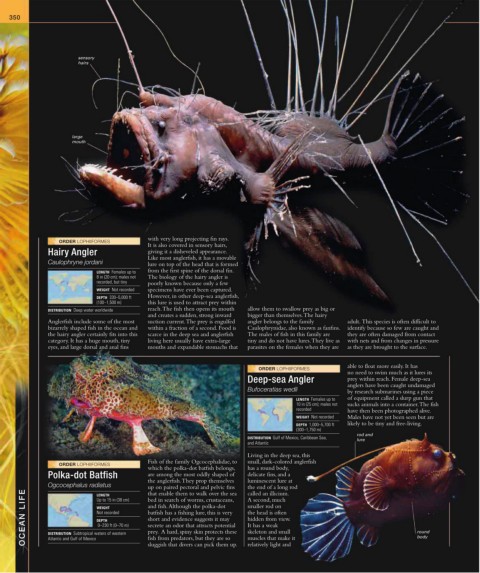
                  ORDER LOPHIIFORMES         with very long projecting fin rays.
                                             It is also covered in sensory hairs,
               Hairy Angler                  giving it a disheveled appearance.
                                             Like most anglerfish, it has a movable
               Caulophryne jordani           lure on top of the head that is formed
                              LENGTH  Females up to    from the first spine of the dorsal fin.
                              8 in (20 cm); males not   The biology of the hairy angler is
                              recorded, but tiny  poorly known because only a few
                              WEIGHT  Not recorded  specimens have ever been captured.
                              DEPTH  330–5,000 ft   However, in other deep-sea anglerfish,
                              (100–1,500 m)  this lure is used to attract prey within
               DISTRIBUTION  Deep water worldwide  reach. The fish then opens its mouth   allow them to swallow prey as big or
                                             and creates a sudden, strong inward   bigger than themselves. The hairy
               Anglerfish include some of the most   suction current. The prey is engulfed   angler belongs to the family   adult. This species is often difficult to
               bizarrely shaped fish in the ocean and   within a fraction of a second. Food is   Caulophrynidae, also known as fanfins.  identify because so few are caught and
               the hairy angler certainly fits into this   scarce in the deep sea and anglerfish   The males of fish in this family are   they are often damaged from contact
               category. It has a huge mouth, tiny   living here usually have extra-large   tiny and do not have lures. They live as  with nets and from changes in pressure
               eyes, and large dorsal and anal fins   mouths and expandable stomachs that   parasites on the females when they are   as they are brought to the surface.


                                                                              ORDER LOPHIIFORMES        able to float more easily. It has
                                                                                                        no need to swim much as it lures its
                                                                           Deep-sea Angler              prey within reach. Female deep-sea
                                                                                                        anglers have been caught undamaged
                                                                           Bufoceratias wedli           by research submarines using a piece
                                                                                         LENGTH  Females up to   of equipment called a slurp gun that
                                                                                         10 in (25 cm); males not   sucks animals into a container. The fish
                                                                                         recorded       have then been photographed alive.
                                                                                         WEIGHT  Not recorded  Males have not yet been seen but are
                                                                                         DEPTH  1,000–5,700 ft   likely to be tiny and free-living.
                                                                                         (300–1,750 m)
                                                                                                           rod and
                                                                           DISTRIBUTION  Gulf of Mexico, Caribbean Sea,    lure
                                                                           and Atlantic
                                                                           Living in the deep sea, this
                                             Fish of the family Ogcocephalidae, to   small, dark-colored anglerfish
                  ORDER LOPHIIFORMES
                                             which the polka-dot batfish belongs,   has a round body,
               Polka-dot Batfish             are among the most oddly shaped of    delicate fins, and a
                                             the anglerfish. They prop themselves   luminescent lure at
                                             up on paired pectoral and pelvic fins   the end of a long rod
               Ogcocephalus radiatus         that enable them to walk over the sea   called an illicium.
        OCEAN LIFE  DISTRIBUTION  Subtropical waters of western   and fish. Although the polka-dot   smaller rod on          round
                              LENGTH
                                                                           A second, much
                                             bed in search of worms, crustaceans,
                              Up to 15 in (38 cm)
                              WEIGHT
                                                                           the head is often
                                             batfish has a fishing lure, this is very
                              Not recorded
                                             short and evidence suggests it may
                                                                           hidden from view.
                              DEPTH
                                             secrete an odor that attracts potential
                                                                           It has a weak
                               0–230 ft (0–70 m)
                                                                           skeleton and small
                                             prey.  A hard, spiny skin protects these
                                                                                                                             body
                                             fish from predators, but they are so
                                                                           muscles that make it
               Atlantic and Gulf of Mexico
                                                                           relatively light and
                                             sluggish that divers can pick them up.

